Short version: a gravel patio costs a fraction of a paver patio and drains better, while a paver patio stays level, holds furniture without wobbling, and keeps stones out of your house. Choose gravel for a fire pit, a garden path, or a seating area set back from the door. Choose pavers for the space right outside your back door where people eat, sit and walk every day.
Most of the regret I see with gravel comes down to placement. A gravel surface that sits ten feet from the house works fine. The same surface pressed against the kitchen door gets tracked inside within a week, no matter how well it was built.
Table of Contents
- Gravel Patio vs Paver Patio at a Glance
- What Is Cheaper: A Gravel Patio or a Paver Patio?
- How Do Gravel Patios and Paver Patios Look?
- Gravel reads soft and informal
- Pavers read built and designed
- The hybrid is the best of both
- Which Patio Surface Is More Comfortable and Practical?
- How a gravel patio vs paver patio feels underfoot
- Furniture and tracking
- Access, heat and grip
- Gravel Patio vs Paver Patio: Installation and Maintenance
- Building a gravel patio
- Building a paver patio
- Ongoing maintenance
- How Durable Are Gravel and Paver Patios?
- Which Patio Surface Handles Drainage and Weather Better?
- Which Should You Choose?
- Frequently Asked Questions
- Is a gravel patio cheaper than a paver patio?
- Are pavers better than gravel for drainage?
- Can you put furniture on a gravel patio?
- Can a gravel patio be converted into a paver patio?
- What patio surface is easiest to maintain?
- How do I stop weeds from growing through a gravel patio?
- Final Verdict for Your Outdoor Space
Gravel Patio vs Paver Patio at a Glance
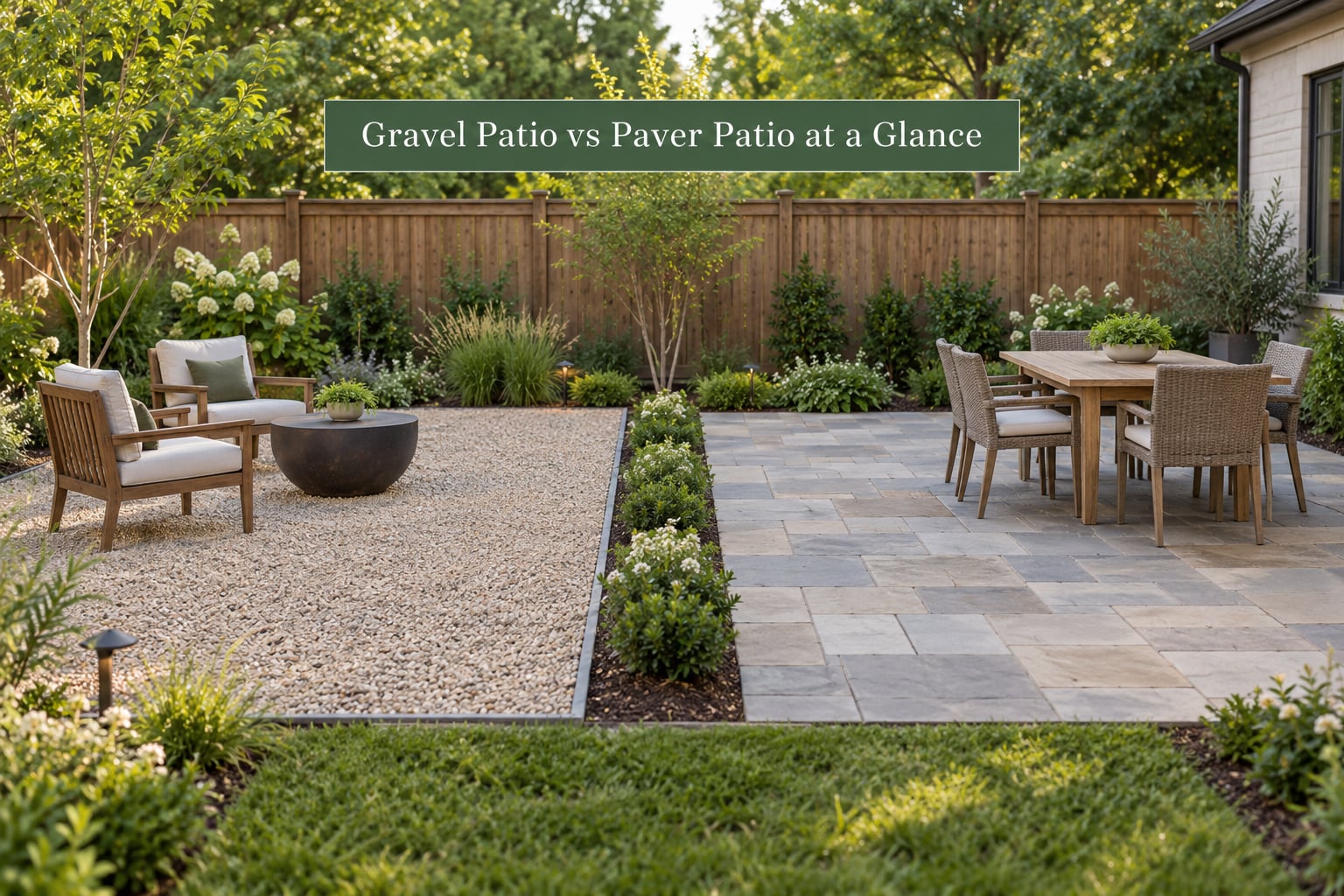
The table below is the honest version of the comparison. It is built around how the surface behaves after a year of use, not how it looks the day it is finished.
| Factor | Gravel patio | Paver patio |
|---|---|---|
| Upfront cost | Low. Material and base only, no setting labor | High. Material, base, leveling sand, hand placement, edge restraint |
| DIY difficulty | Moderate. Mostly digging, spreading and compacting | High. Cutting, aligning and leveling every piece |
| Appearance | Soft and informal, blends into beds | Clean and designed, strong curb appeal |
| Walking comfort | Depends entirely on the stone. Rounded gravel gives way | Even and predictable underfoot |
| Furniture stability | Wobbly on rounded stone, firm on crushed or DG | Rock solid, legs stay level |
| Tracking indoors | Common. Stone and fine dust come in on shoes | Rare. You sweep instead of scrub |
| Drainage | Excellent. Water moves down through the whole surface | Good. Water runs through the joints onto a sloped base |
| Maintenance | Rake, weed, top up every few years | Sweep, blow leaves, refresh joint sand |
| Weeds | Persistent. They germinate in the dust between stones | Limited to the joints unless polymeric sand is used |
| Repairs | Rake it flat, add stone. Very easy | Pull two pieces, reset them. Very easy |
| Access | Difficult for wheelchairs, walkers, strollers and grill carts | Firm and rollable |
| Lifespan | Long, as long as you keep topping it up | Decades, with the surface intact |
| Best for | Secondary areas, fire pits, paths, under trees | The main patio off the house, dining, high traffic |
One row deserves emphasis. A gravel patio is only as walkable as the stone you choose, and the cheapest decorative gravel is the worst walking surface you can buy. That single decision explains most of the bad experiences people share online.
What Is Cheaper: A Gravel Patio or a Paver Patio?
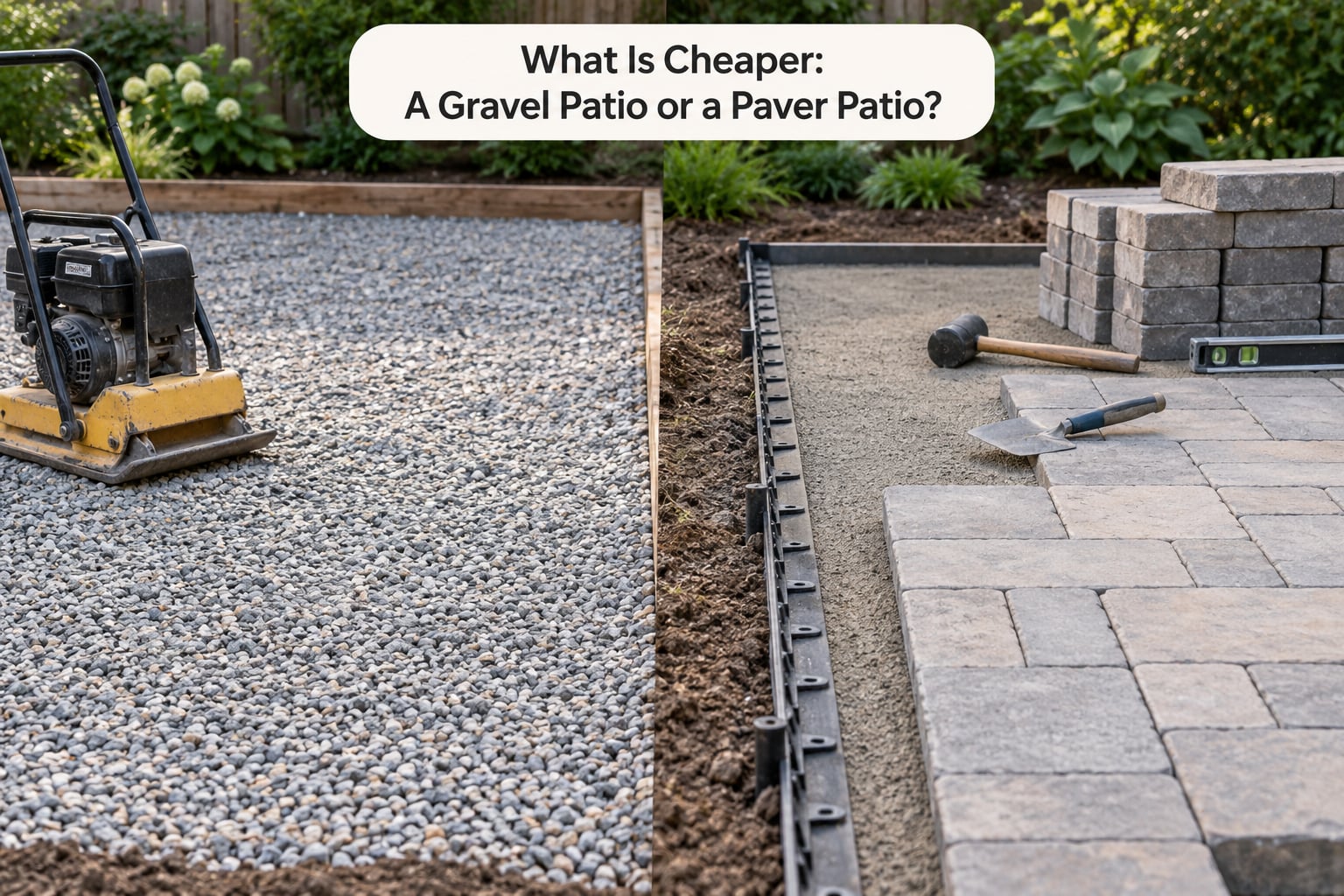
Gravel wins on upfront cost, and it is not a close call. A gravel patio is mostly material and a machine or two: excavation, a base layer, geotextile, stone, edging and compaction. There is no setting labor, because nothing is placed one piece at a time.
A paver patio adds a full day or more of work per hundred square feet. Someone cuts pieces to fit the edges, sets a leveling course, aligns every unit to a string line, and locks the border with rigid edge restraint so the whole field cannot walk outward over the years. Add polymeric sand for the joints and the material cost climbs again.
Roughly speaking, a gravel patio lands somewhere in the low single digits per square foot installed, while a paver patio lands in the tens per square foot. Regional pricing swings hard, especially where paver labor is scarce, so treat those as shapes rather than quotes.
What moves a gravel total more than the stone itself is site access and base depth. A tight side yard means hand-digging. Slope and clay subgrade mean hauling out a lot of material, and every yard that comes out is another yard that goes somewhere.
What moves a paver total is the base specification. A compacted crushed-stone base is the standard. Ask for a concrete base and the project changes character and price, and you are effectively building a slab out of stones on top of it.
The long-term math matters too. Gravel needs a fresh layer every few years as it settles into the subgrade, and that labor adds up across a decade. Pavers hold their finished surface, so the main recurring cost is joint sand and a sweep. Gravel is cheaper to install; pavers are cheaper to keep.
Get three written quotes either way, and make sure each one lists the same scope: base depth, geotextile, edging, and disposal. Quotes are only comparable when the scope matches.
How Do Gravel Patios and Paver Patios Look?
Gravel reads soft and informal
Decomp Houzz homeowners describe the look as an extension of the garden rather than a room. Tan decomposed granite against green beds feels natural. Pale pea gravel reads beachy and loose, and a grey crushed blend looks tidy next to modern siding.
The trade-off is precision. Gravel has no pattern, no joint lines and no straight course, so a small area looks forgiving and a large one can look unfinished. Edging does most of the visual work here. Steel, timber and stone borders are what stop the surface from reading as a pile of rock.
Pavers read built and designed
Pavers give you pattern, color choice and a visible grid. Running bond, herringbone or a two-tone mix all change the feel of the same yard. Because the surface is level and uniform, it holds a furniture grouping in a way gravel rarely can, and buyers read that as an upgrade when the house comes up for sale.
The honest drawback is that a paver patio can look wrong. A mismatched paver, a cut too tight along an edge, or a base that settled in one corner shows up immediately in a way loose stone hides. Good paver work is not fussy, but it is visible.
The hybrid is the best of both
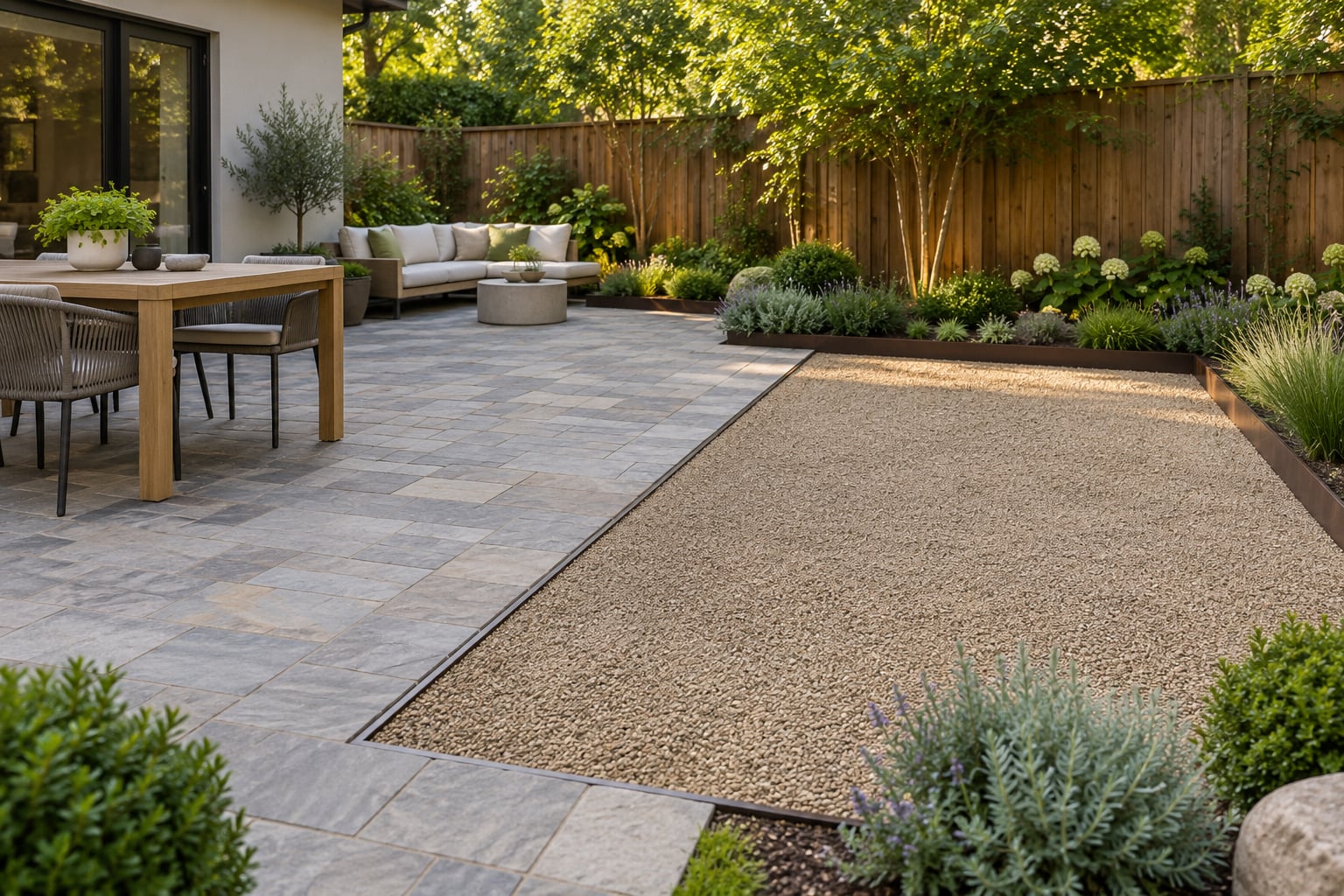
The pattern I recommend most often is splitting the space. Pavers go where furniture sits and feet land every day. Gravel covers the fire pit area, the path to the shed, and the strip under the trees. The stepping-stone or paver-in-gravel checkerboard idea does the same thing in a smaller footprint, and it lets you stage the expensive surface over a few seasons instead of all at once.
Which Patio Surface Is More Comfortable and Practical?
How a gravel patio vs paver patio feels underfoot
This is where the two surfaces separate fastest. Compacted angular crushed stone or decomposed granite feels firm and nearly flat once it is locked together. Rounded pea gravel behaves like ball bearings underfoot, scatters sideways, and leaves furniture legs sitting in a dip. That is not a preference, it is the shape of the stone.
The same material problem shows up in carts and grills. A wheeled grill, a wheelbarrow or a stroller crosses a well-compacted crushed surface slowly but predictably. Across loose rounded gravel it lurches. A featured Houzz answer put it plainly: rounded pea gravel gives way underfoot, which is why people who blame poor preparation are often blaming the wrong thing.
Furniture and tracking
On pavers, a dining table sits where you put it for twenty years. On a crushed gravel pad you may need shims after a winter, but the surface is firm enough for most people. On pea gravel, plan on shims every time, or plan on not using a dining set at all.
Tracking is the deciding factor for many households. A featured Houzz homeowner described living with a gravel patio for a year or two while saving for pavers and hating the constant shoe cleaning before coming inside. Pavers ended the problem completely. The practical rule homeowners repeat: gravel works well when it is set back far enough from the house that dirt scrubs off on the way in.
Access, heat and grip
Wheelchairs, walkers and strollers cross pavers without an argument. On gravel they need a smooth path, which usually means building part of your patio in pavers anyway.
Both surfaces run warmer than shaded grass, and pavers store more heat through the day than a gravel surface with air spaces between the stones. On a July afternoon, a dark paver patio off a south-facing wall is the hotter of the two. Both are slip-resistant when dry; a power-washed paver surface is slicker than gravel until it dries.
Gravel Patio vs Paver Patio: Installation and Maintenance
Both surfaces start the same way, and this is where most projects go wrong. You excavate, lay geotextile fabric over the subgrade, build up compacted crushed base, and grade away from the house.
Building a gravel patio
- Excavate and line. Dig below the topsoil, then lay geotextile fabric with every seam taped. Fabric stops soil mixing into the stone. It does not stop weeds that germinate in the dust on top.
- Build the base. Six inches of compacted crushed road base, compacted in layers, is the usual target for a surface that carries foot traffic. Compact in thin lifts; a thick layer pumped up in the middle and never sets.
- Add the walking surface. Three to four inches of 3/8-inch minus crushed stone or decomposed granite, compacted again. This is the layer people want to skip, and it is the layer that makes the patio walkable.
- Edge it. Steel, timber or stone edging holds the surface in place. Without a rigid edge, gravel migrates into the lawn and the beds, exactly as it does at a driveway apron.
Building a paver patio
The base work is the same, then a layer of leveling sand goes down and the pieces get set on top. The finished grade depends on that base being right, so a paver project with a rushed base is a paver project that will settle and rock within a few winters. Edge restraint holds the field together and stops the outer course from walking outward.
Ongoing maintenance
- Top off gravel every few years as it settles, then rake it back to an even depth.
- Pull weeds early in gravel. They arrive in accumulated dust, and the ones that survive go to seed fast.
- Vacuum or blow pavers rather than shoveling, and blow leaves out of the joints in the fall.
- Refresh paver joints with polymeric sand so the joints stop washing out and stop hosting weeds.
- Snow is easier on pavers, which can be shoveled cleanly. A metal snow edge on a gravel patio gets sand mixed into it all winter.
Neither surface needs sealing or staining. That single fact removes the most common recurring cost people expect in a patio project.
How Durable Are Gravel and Paver Patios?
Durability here does not mean the material survives. It means the surface still looks intentional after a few hard winters.
A gravel patio is durable but consumable. The stone does not break down, but it does settle, and foot traffic creates ruts and low spots near doors, seating areas and the grill. Because stone is loose, repair is trivial. Rake it flat, add a layer, compact it. That is a Sunday morning, not a contractor visit.
Pavers are durable in a different way. Individual pieces can crack or shift, and the worst of it can be pulled out and reset without disturbing the rest. Sand-base paver patios can settle enough in heavy soil to rock underfoot, which is a base problem rather than a paver problem.
Freeze-thaw is the same test for both. A surface that drains through its whole depth and sits on compacted base moves with the ground. A surface with a low spot traps water, and that water is what lifts and cracks in winter. In r/landscaping threads about fire pit surfaces, the recurring theme was that the material choice mattered less than the preparation underneath it.
Where the two really diverge is appearance over time. Gravel looks disturbed after a season of use and needs a top-off to look intentional again. Pavers look the same in year ten as in year one, apart from the joints.
Which Patio Surface Handles Drainage and Weather Better?
Gravel is the better surface on raw drainage. Water moves down between the stones instead of sitting on top, so a heavy rain soaks in rather than ponding. Pavers are slower, since water has to pass through the joints, but on a properly graded and compacted base they shed rain cleanly.
Neither surface fixes a patio that was built flat. Ponding, ice heave and a persistently wet patch are all grade and drainage failures, not material failures. Most patios that pool were installed without a slope, and the fix is regrading rather than swapping surfaces.
Plan a slope of roughly two percent away from the house, and keep soil, mulch and planting beds from washing onto the surface. Rain runoff from a roof or an upper slope should be diverted around the patio rather than across it.
For weeds, gravel loses. Because it stays dry on top and collects dust in the spaces between stones, it is a decent seedbed. Pavers with polymeric sand hold their joints far better. If weeds are the thing that annoys you most, that is a real argument for pavers.
For heat, gravel has a small edge in full sun because the air gaps between stones release heat faster than a solid paver slab.
Which Should You Choose?
Choose a gravel patio when the space is secondary, the budget is the deciding factor, or the surface sits under trees where roots and shade make a paver base difficult. Gravel is a good answer for a fire pit surround, a path to a garden, a dog run, an RV parking pad, or a rental property where you want a durable surface without a large invoice.
Choose a paver patio when the space is the main outdoor room, when furniture must sit level, when anyone in the house uses a wheelchair, walker or stroller, or when the surface sits right against the house. You also want pavers if tracking grit indoors would end the experiment quickly, or if the look of the yard matters to you at resale.
Skip rounded pea gravel as a walking surface. If you want gravel, use angular crushed material or decomposed granite over a properly compacted base, and set it back from the door.
Split the difference when you can. A paver patio where the dining table goes, gravel everywhere else around it, gives you the level surface where it matters and saves most of the material cost on the areas that only see feet.
Frequently Asked Questions
Is a gravel patio cheaper than a paver patio?
Yes, most of the time. Gravel patios cost a fraction of a paver patio because the material is cheap and the labor stops after compaction. Pavers add leveling sand, hand placement, edge restraint and joint work, and specifying a concrete base pushes the figure higher. Regional pricing varies widely, so compare three written quotes with the same scope.
Are pavers better than gravel for drainage?
Gravel is better on drainage. Water moves down through the entire gravel surface rather than sitting on top, so heavy rain soaks in. Pavers shed water through the joints onto a sloped, compacted base, which works well when built correctly. Neither rescues a flat patio, so grade away from the house at roughly a two percent slope.
Can you put furniture on a gravel patio?
You can, but only on a surface that compacts. Rounded pea gravel gives way underfoot, so table and chair legs sink and rock. Angular crushed material such as 3/8-inch minus or decomposed granite packs into a firm pad that holds a dining set. Even then, level the base before you set anything on it, because furniture finds every dip.
Can a gravel patio be converted into a paver patio?
Yes, and it is one of the better reasons to start with gravel. Dig off the top stone, keep the compacted base if it is solid, add leveling sand and edge restraint, and set the pavers on top. If the base has soft spots or gravel has migrated into your lawn and beds, expect to remove and replace part of it first.
What patio surface is easiest to maintain?
Pavers, in most yards. Sweep them, blow the leaves out, and refresh polymeric sand in the joints every few years. Gravel needs raking to redistribute stone, regular weeding, and a fresh layer as it settles into the subgrade. Neither surface needs sealing, which is the one job a paver patio saves you entirely.
How do I stop weeds from growing through a gravel patio?
Start at the base. Lay geotextile fabric over the compacted subgrade and under the stone, and tape every seam. Weeds still germinate in the dust that collects between the stones on top, so pull them young and keep the surface topped up. Herbicides work on a cleared patio, but the spray often kills nearby plants along with the weeds.
Final Verdict for Your Outdoor Space
A gravel patio is the right call when you want a durable surface for a secondary area and the budget is real. A paver patio is the right call when the space is the one you will actually use every day, and when the surface has to hold furniture level and keep grit out of the house. In most yards the answer is both, with pavers where people sit and gravel everywhere else.
Start by measuring the area and sketching where furniture goes, then check how water leaves that spot today. Set a budget you can cover without borrowing, and match the surface to how you will use the space rather than to how it looks in a photo. Get three written quotes with identical scope, and you will find the choice makes itself.