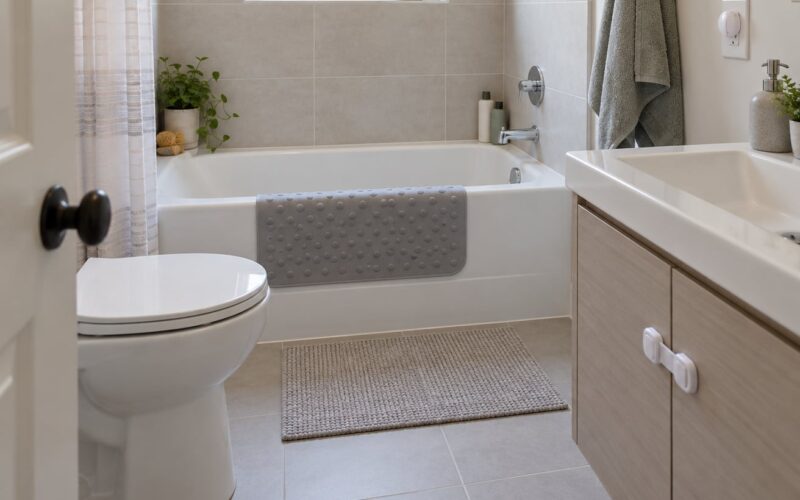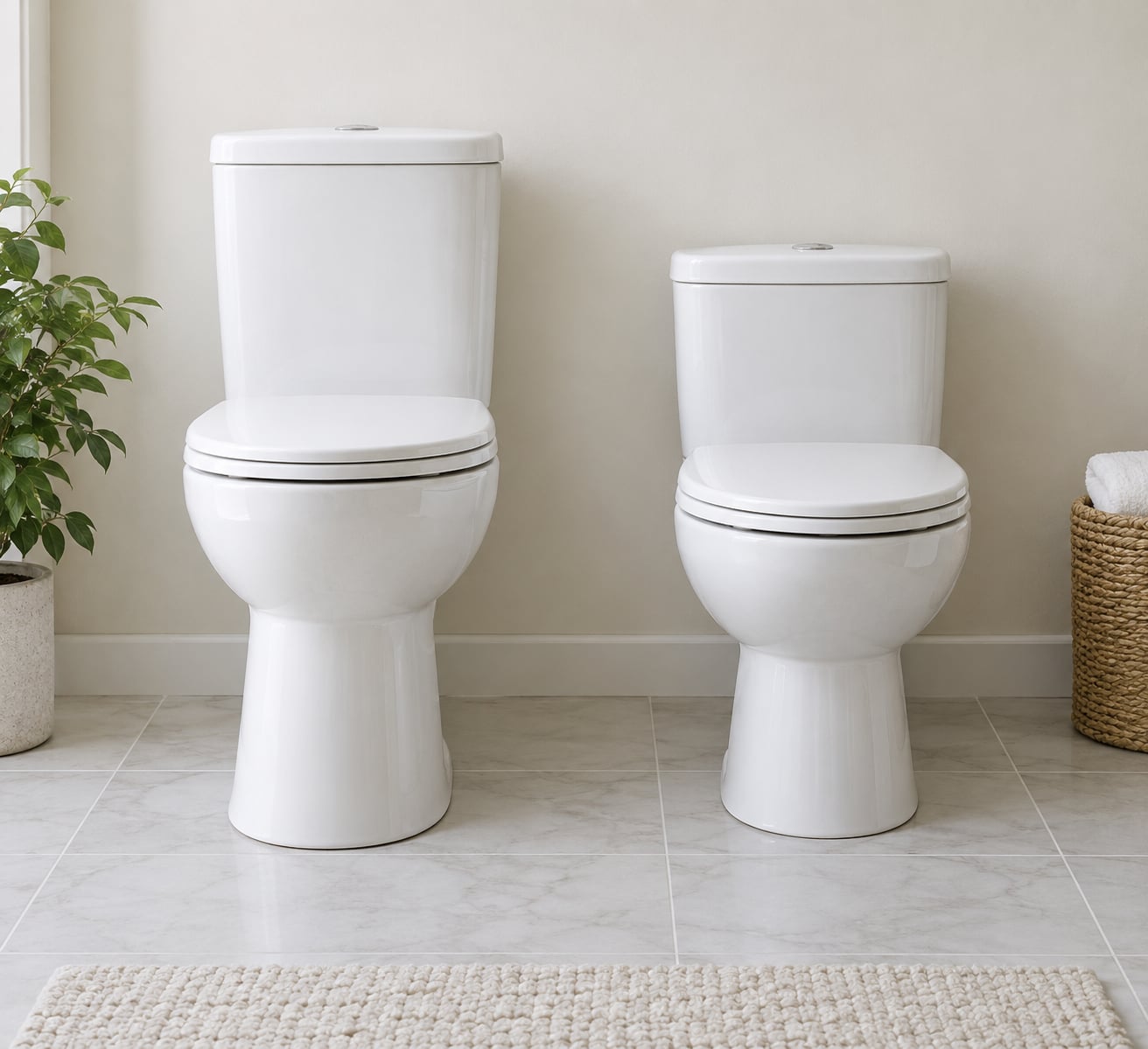
Short answer on comfort height vs standard toilet: it is about three inches of seat height, and the right choice depends on who uses the bathroom. A standard toilet puts the top of the seat roughly 14.5 to 16 inches off the floor, while a comfort height toilet, also called a chair height or convenient height toilet, sits around 17 to 19 inches. Taller helps adults who struggle to stand up from a low bowl. Shorter helps children and adults under about five foot three whose feet cannot reach the floor on a high seat.
Most homes that get a comfort height toilet by accident are the result of a contractor defaulting to the modern option without asking anyone in the house. That is the most common complaint in homeowner forums, and it is avoidable if you say what you want before the flange gets set.
Table of Contents
- Comfort Height vs Standard Toilet at a Glance
- Seat Height and Everyday Comfort
- How comfort height vs standard toilet ergonomics actually differ
- Accessibility and Household Users
- Who benefits most from a comfort height toilet
- Who is better served by a standard height toilet
- What ADA compliance actually requires
- Why contractors default to comfort height
- Cleaning and Maintenance
- Appearance, Space, and Bathroom Design
- Installation and Replacement Considerations
- Which Should You Choose?
- Frequently Asked Questions
- What is the difference between a comfort-height and standard toilet?
- Are comfort-height toilets required by the ADA?
- Are comfort-height toilets harder to install than standard toilets?
- Is a comfort-height toilet more comfortable for everyone?
- Can I replace a standard toilet with a comfort-height model?
- What to Do First
Comfort Height vs Standard Toilet at a Glance
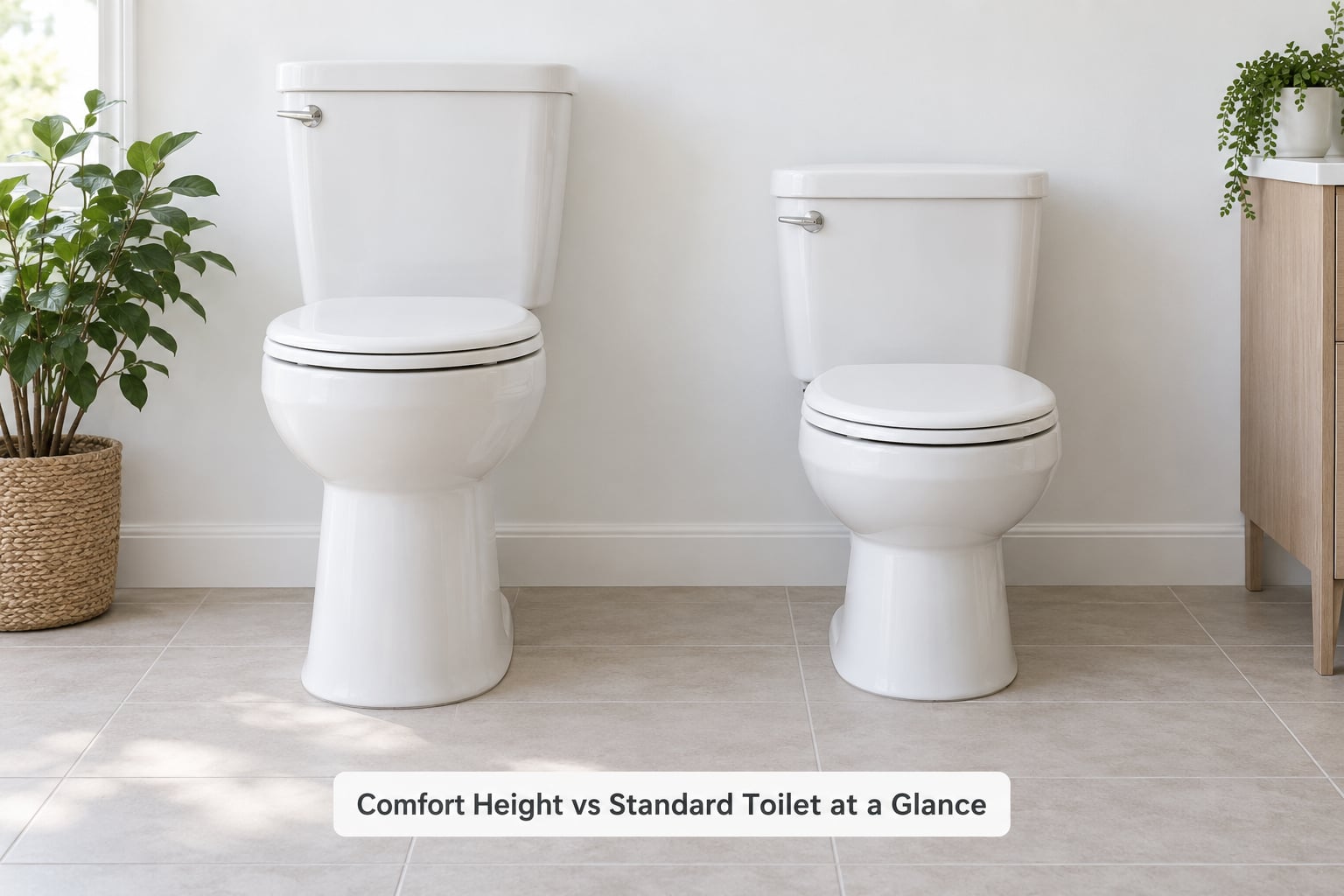
The table below compares the two toilet heights on the factors that actually change day to day. Measurements are floor to the top of the seat, the same way most manufacturers list them.
| Criterion | Standard height toilet | Comfort height toilet |
|---|---|---|
| Seat height, floor to top of seat | About 14.5 to 16 inches | About 17 to 19 inches |
| Also called | Regular height, low tank | Chair height, convenient height, tall toilet |
| Best users | Children, adults under about five foot three, adults who lower and stand without help | Adults over five foot four, seniors, tall adults, anyone with knee, hip or back pain or limited mobility |
| Foot position | Feet flat on the floor for most adults | Feet may not reach flat on a low seat; a small step stool helps shorter users |
| Accessibility | Not an ADA seat height | Usual adult ADA seat range, but full compliance also depends on grab bars, clearances and the water closet as a whole |
| Cleaning reach | Less bending over the bowl | Slightly more reach into the bowl and under the rim |
| Visual effect in the room | Lower profile, matches traditional and small bathrooms | Draws the eye upward, matches modern fixtures and taller vanities |
| Small bathroom fit | Easier in tight rooms where the bowl already crowds the door | Taller tanks can conflict with a door swing or a close lavatory |
| Installation | Standard rough-in and flange work | Same rough-in in most cases; verify tank height against the wall and the door swing |
Seat Height and Everyday Comfort
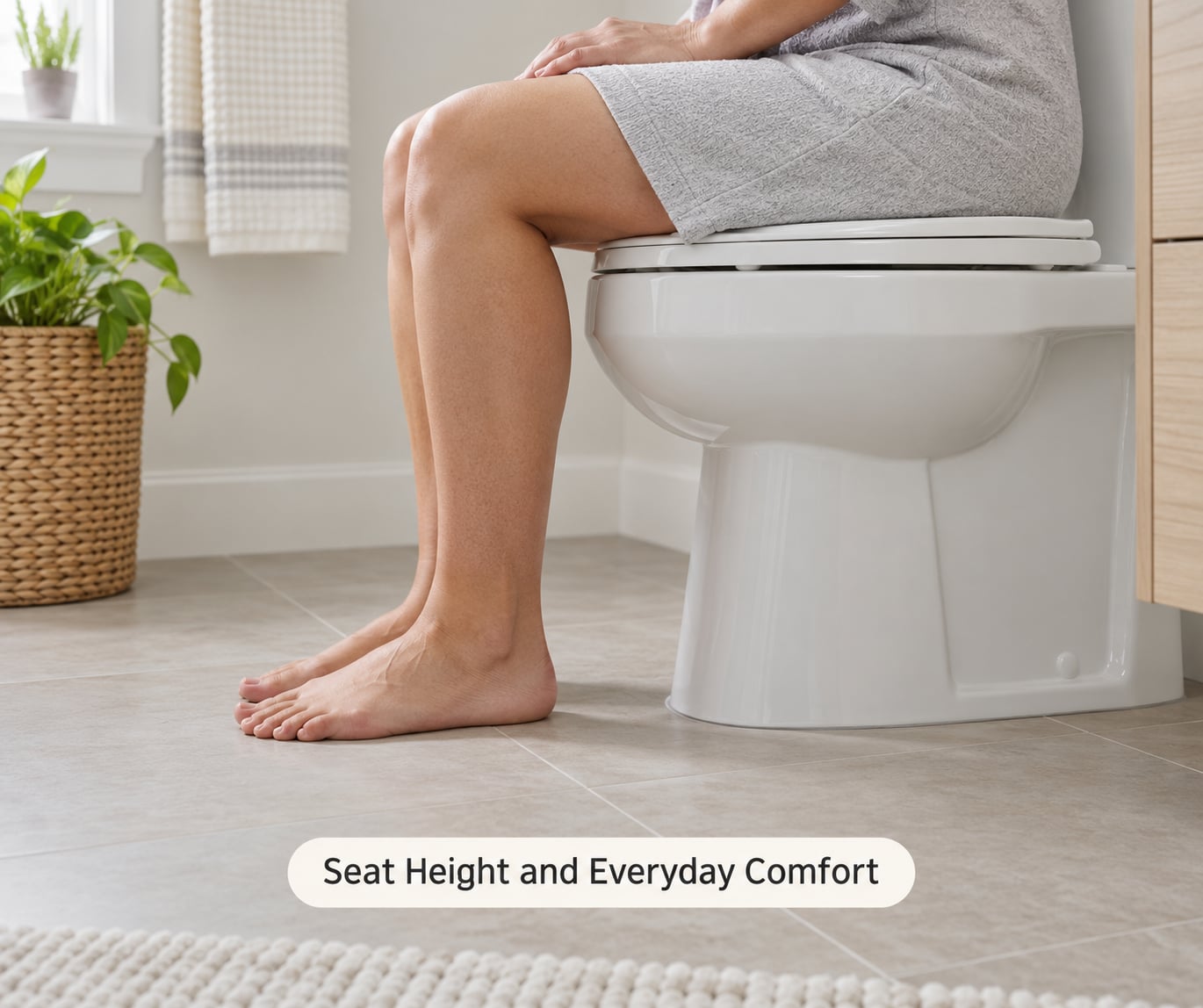
How comfort height vs standard toilet ergonomics actually differ
Three inches sounds minor until you sit down on it fifty times a day. Rising from a low bowl means pushing through a deeper knee bend, and that push is exactly what people with knee arthritis, hip problems, or a stiff lower back find hardest. Raising the seat shortens the range your legs have to travel, which is why a comfort height toilet reads as easier to use to older adults.
There is a catch. When the seat is above knee height, the feet dangle, and a dangling body cannot balance itself well. Shorter users often report that a comfort height toilet makes them grip the bowl edge to steady themselves. A r/bathrooms regular put a rough threshold on it: at about five foot three and under, standard height is the more comfortable option for them. Over six feet, the opposite is often true, since a standard bowl leaves the knees cramped.
One measurement detail explains most of the conflicting numbers you will find online. Some sources quote the floor to the top of the bowl rim, others the floor to the top of the seat, and a seat adds roughly an inch or two. Before you shop, measure your current toilet yourself: sit a tape measure on the floor beside the bowl and read up to the seat surface. Knowing your starting number is more useful than any brand label, and it takes under a minute.
Accessibility and Household Users
Who benefits most from a comfort height toilet
Adults over five foot four, especially anyone over six feet, get a better hip angle on a taller bowl. So do seniors planning to age in place, since a higher seat reduces the effort needed to stand and lowers the chance of a fall in a tiled room.
People recovering from hip, knee, or spinal surgery fall into the same group. So do users of walkers and wheelchairs, since a transfer from a higher seat means less lifting. If your household includes an adult with limited mobility, comfort height is the safer default.
Who is better served by a standard height toilet
Children are the clearest case. A five year old can manage a seventeen inch seat with a step stool, but they do not need to, and a lower bowl lets them reach the floor for balance. Adults under about five foot three report the same thing.
Anyone who sits down and stands back up without thinking about it does not need a taller bowl. Plumbers and remodelers often point out that if you can rise from a standard toilet without bracing your hands, the extra height buys you nothing. One Houzz homeowner who replaced an old, unusually low toilet with a standard model found the standard height noticeably more comfortable than what they had before.
What ADA compliance actually requires
ADA section 604.4 sets the adult accessible water closet seat at sixteen inches minimum and seventeen inches maximum, measured to the top of the seat. Most comfort height toilets land inside that band, but a seat height alone does not make a bathroom compliant. The standard also covers grab bar placement, clear floor space, flush controls and the flushometer location, so a single toilet cannot make a bathroom ADA.
Why contractors default to comfort height
Plumbers and remodelers install taller bowls by default because comfort height is what most current production models are, and it is what they have on the truck. A r/firstworldproblems thread titled around a contractor convincing a household to take comfort height drew a loud consensus back the other way. The fix is simple and works: tell your contractor the seat height you want, in inches, before the flange is set, and put it in the written scope. If you already own a comfort height toilet and it feels wrong, an adjustable or bidet seat is a reversible middle option.
Cleaning and Maintenance
Height alone decides very little about how hard a toilet is to clean. What people actually notice is reach. With a comfort height bowl, the inside surface is closer to shoulder level, so scrubbing the back of the bowl takes less crouching. A r/Plumbing renovator who had just installed an eighteen inch tub said the tall fixtures felt claustrophobic, which is a spacing reaction rather than a cleaning one.
A taller tank is the piece most likely to create real cleaning work. High tank designs and skirted bases trap less dust underneath but hide the floor edge, so a damp cloth has to reach further back. Low tank and standard two piece models leave an open base you can wipe in seconds.
Everything else on the maintenance list is identical between the two heights. Flush performance comes down to the trapway, the flush system, and gallons per flush rather than seat height. Look for a WaterSense labeled model at 1.28 gallons per flush or less, and expect the same wax ring, supply line, and fill valve service on either type.
Appearance, Space, and Bathroom Design
A taller bowl and tank shift the visual weight upward. In a bathroom with a 36 inch vanity counter and a raised faucet, a comfort height toilet lines up instead of looking undersized. In a half bath with a low window or wainscoting, the same toilet can crowd the wall and make the room feel tight.
Clearance is where small bathrooms get real problems. Aim for at least 15 inches from the centerline of the bowl to any obstruction in front of it, and about 12 inches from the centerline to a side wall or adjacent fixture. Many homes fall below that before anything is installed. The height change itself does not eat that floor space, but the taller tank behind the bowl can catch a door that swings inward, which is the failure homeowners report most often.
Bowl shape interacts with fit too. An elongated bowl is more comfortable and projects roughly two inches farther into the room than a round bowl, and elongated comfort height models are easier to find than elongated standard height ones. In a cramped powder room, a round standard height bowl may be the only combination that closes without crowding. Check the projection from the wall to the front of the bowl before you order.
Installation and Replacement Considerations
Height rarely changes the plumbing, but it changes what you have to check. Before you replace an existing toilet, run through this list:
- Measure the rough-in. The distance from the finished wall to the center of the flange bolts should be 12 inches in nearly every US home. Ten inch and fourteen inch rough-ins exist in older houses, and a model with the wrong footprint will not sit flat.
- Check the bowl projection. Measure from the wall to the front of the old bowl and compare it with the new model, especially in a room under five feet wide.
- Look at the tank height against the wall. Comfort height tanks sit higher, so check for a windowsill, a wainscot cap, or a wall outlet that the new tank would hit.
- Swing the bathroom door open fully. A taller tank plus an inward swinging door is a common last minute conflict.
- Confirm flange compatibility. The flange stays with the floor, so a new bowl must match its bolt pattern and mounting style. Replace a wax ring or rubber gasket while the old toilet is out.
- Check water efficiency and local codes. WaterSense labeling at 1.28 gallons per flush or less is the benchmark most codes point toward, and some jurisdictions require low flow fixtures at replacement.
- Confirm the floor and supply line suit the model. Rear or bottom outlet supply lines and uneven floors can limit which models seat properly.
If any of those checks fail, the fix is usually a different model rather than more work on the floor. A licensed plumber should handle anything where the flange is damaged, the drain line needs work, or you are moving the drain location.
Which Should You Choose?
So the comfort height vs standard toilet question is less about which type is better and more about whether the tallest and shortest people in the house can both use it well. When a household is mixed, that single consideration usually outweighs the general trend toward taller fixtures.
Choose a comfort height toilet when seniors, adults over six feet, or anyone with knee, hip, back, or mobility issues use the bathroom. It is also the right call for aging in place renovations, for a primary bathroom where taller users spend most of their time, and for most new construction.
Choose a standard height toilet in a compact half bath where the bowl already crowds the room, in a bathroom with traditional low fixtures, for a home with young children as the primary users, and for any replacement where every adult in the house rises from a low seat without effort.
Mixed households need a judgment call. A reasonable compromise is a comfort height toilet in the full bathroom used by adults and a standard height toilet in the kids’ bathroom or powder room. If you are unsure, the reversible move is to start with comfort height and keep the seat replaceable.
Frequently Asked Questions
What is the difference between a comfort-height and standard toilet?
A standard toilet has a seat about 14.5 to 16 inches above the floor. A comfort height toilet, also called a chair height toilet, has a seat about 17 to 19 inches above the floor. That extra three inches makes sitting down and standing up easier for adults with mobility limits, while a standard seat lets shorter users keep both feet flat on the floor.
Are comfort-height toilets required by the ADA?
No. ADA section 604.4 sets the adult accessible water closet seat between 16 and 17 inches, so most comfort height toilets fall inside that range, but the full standard also covers grab bars, clear floor space and flush controls. A single toilet cannot make a bathroom accessible on its own. Residential bathrooms you build yourself are not required to comply unless you are building for accessibility.
Are comfort-height toilets harder to install than standard toilets?
Usually not. Both use the same rough-in, flange and supply connection, and the bowl itself does not change. What changes is tank height and overall projection, which can conflict with a window ledge, an outlet, or a bathroom door that swings inward. Measure those before ordering and installation is routine for a licensed plumber.
Is a comfort-height toilet more comfortable for everyone?
No. Comfort height is easier to stand up from, but a seat above knee height leaves shorter users dangling, and dangling feet make it harder to balance. Adults around five foot three and under, young children, and anyone who rises from a low seat without strain are usually more comfortable on a standard height bowl.
Can I replace a standard toilet with a comfort-height model?
In most homes you can, because the rough-in distance from the wall to the flange bolts rarely changes. Check that the new bowl matches your 12 inch rough-in, that the footprint fits the space, and that the taller tank clears the wall, the outlet, and the door swing. If the flange is damaged or the drain line needs moving, call a plumber.
What to Do First
Measure the seat height of your current toilet and write it down, and note which side of the comfort height vs standard toilet question that number already answers. Then list who actually uses that bathroom, by height and by mobility, and tell your contractor the number you want in inches before work starts. That single conversation prevents most of the disappointments homeowners complain about online.