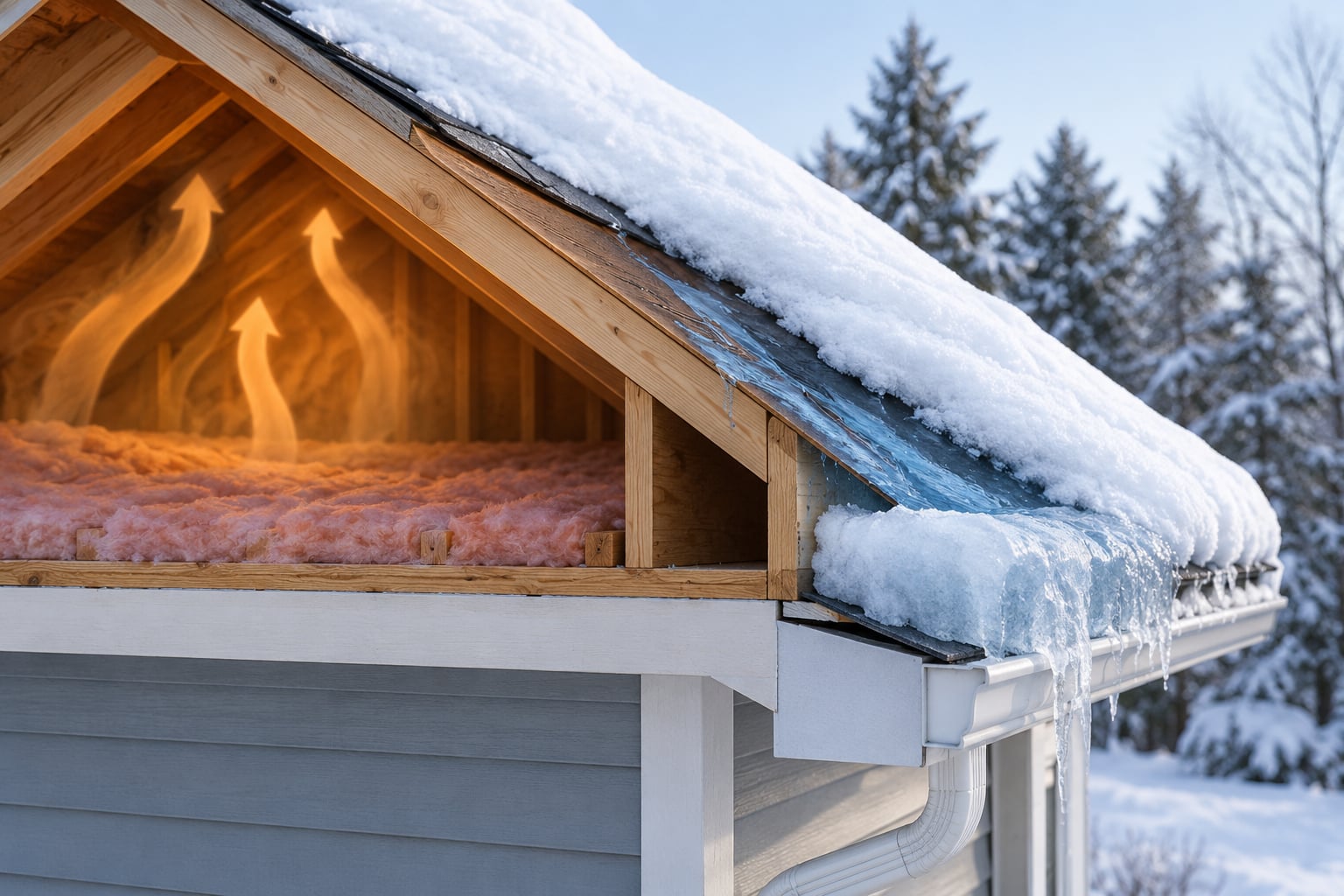
Ice dams form when heat escaping from a heated living space warms the attic, melts the underside of the snow sitting on the roof, and the meltwater refreezes at the cold eave overhang before it can drain away. That ridge of ice blocks runoff, so water backs up under the shingles and finds its way in at the ceiling. The short answer to what causes ice dams on roofs comes down to three things at once: heat loss from inside, snow cover on the deck, and temperatures that drop below freezing at the right moment.
That combination is why dams show up in the northern half of the country and rarely anywhere else. A roof rake clears the symptom, but if the heat keeps coming up into the attic, the same dam rebuilds every winter. This guide covers how the ice actually forms, how to tell a dam apart from ordinary snow, what damage it does, and which fixes are worth doing.
Table of Contents
- How Ice Dams Form on a Roof
- What Causes Ice Dams on Roofs?
- What Makes Some Roofs More Prone to Ice Dams?
- How to Tell an Ice Dam from Ordinary Snow and Icicles
- What Damage Can an Ice Dam Cause?
- Can You Remove an Ice Dam Safely?
- How to Prevent Ice Dams on Roofs
- What Should You Do When You Notice an Ice Dam?
- Frequently Asked Questions
- Do ice dams mean my roof is bad?
- Should I remove ice from my roof?
- How much attic insulation is needed to prevent ice dams?
- Are roof gutters supposed to prevent ice dams?
- Will insurance cover damage caused by an ice dam?
- Conclusion
How Ice Dams Form on a Roof
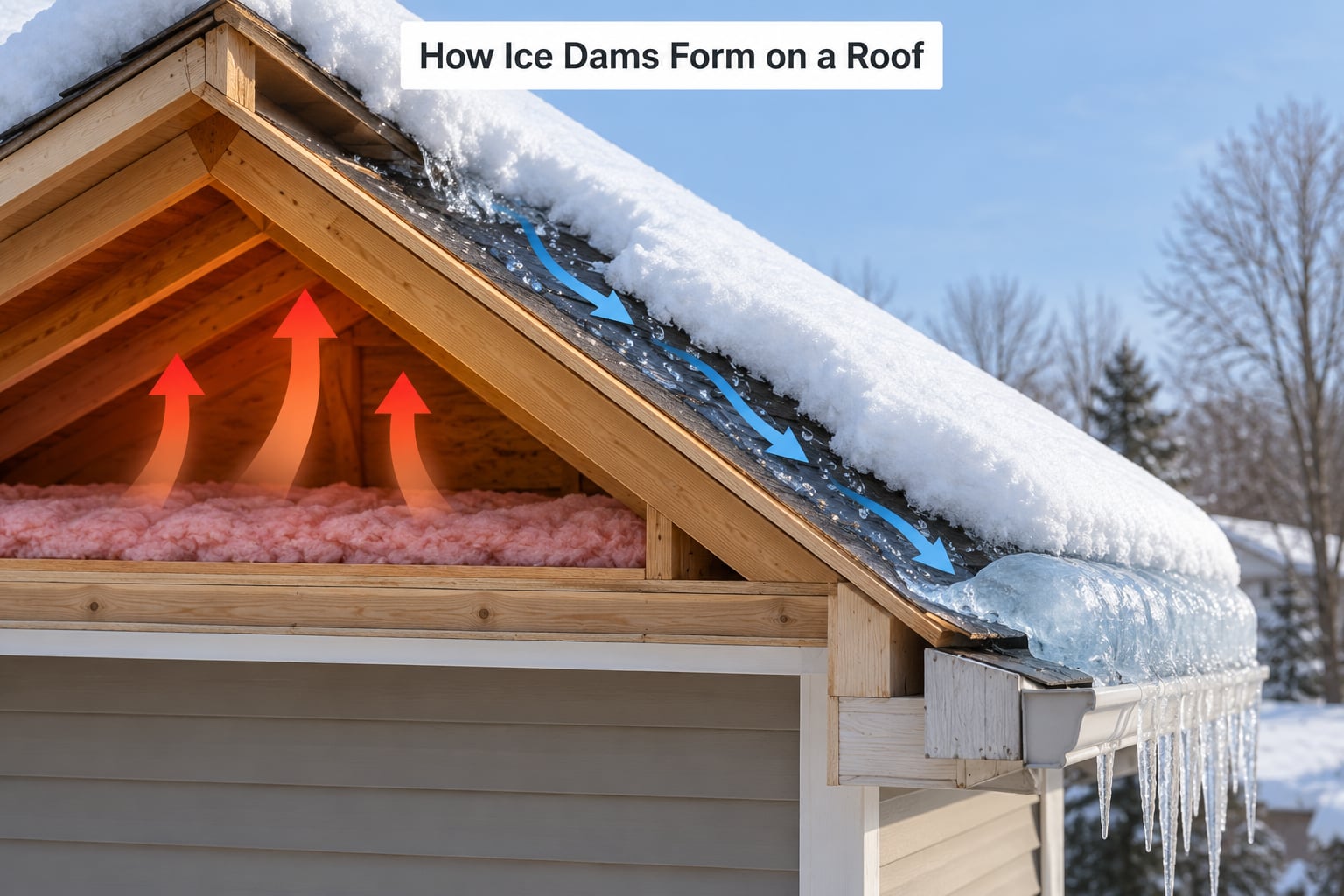
Every ice dam follows the same four-step sequence, and each step depends on the one before it.
1. Heat escapes into the attic. Warm air from living space leaks upward through the ceiling plane, through holes around pipes and wiring, and into the attic space. The attic warms, and the roof sheathing (the plywood or OSB deck attached to the rafters) warms with it.
2. Snow on the deck starts to melt from underneath. If the underside of the snow pack rises above 32°F, it melts even while the air outside stays well below freezing. The melt starts at the ridge, where the attic air is hottest, and often goes unnoticed because the top of the snow is still frozen solid.
3. Meltwater runs down the slope to a colder edge. Water has no frozen layer blocking it, so it runs down the deck past the insulation and out over the eave overhang. The overhang sits outside the wall line, so nothing inside the house is heating it. Its temperature tracks the outdoor air, which research on roof ice dams puts around 22°F or lower while the roof deck itself is above 30°F.
4. The water refreezes and builds a dam. At that point the water refreezes into a ridge of ice across the eave. Snow keeps melting above it, runoff keeps arriving, and the dam grows until it holds several inches of water behind it. That trapped water is what causes winter ceiling leaks.
The National Weather Service describes the same pattern in its guidance on roof ice dams: heavy snow melts during the day and refreezes at the coldest part of the roof when temperatures drop overnight. University of Minnesota Extension frames it the same way, noting that nonuniform roof surface temperatures are the underlying condition.
What Causes Ice Dams on Roofs?
In short, what causes ice dams on roofs is heat loss into an inadequately insulated and unsealed attic combined with snow and a freeze-thaw cycle. The specific contributors usually look like this:
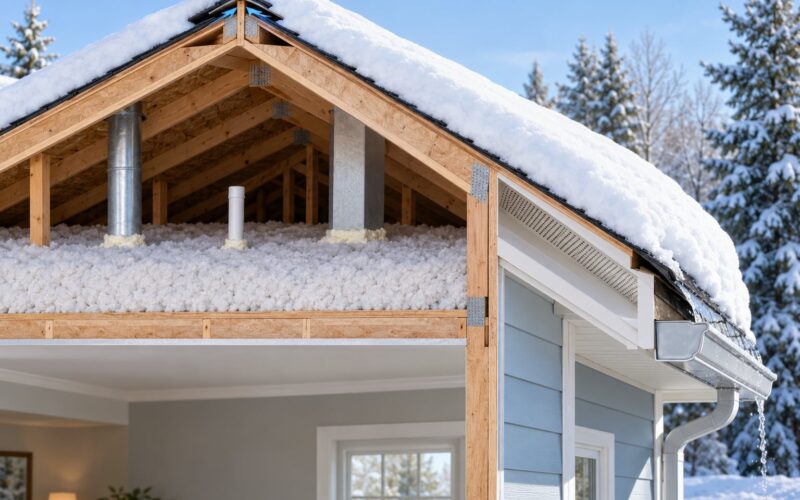
- Insufficient attic insulation. Fiberglass batts settled or compressed, or cellulose that has sunk over the years, leaves the deck exposed to indoor heat. Most cold-climate guidance points to R-30 to R-50 in the attic depending on zone, and many older homes sit well below that.
- Air leaks through the ceiling. An unsealed attic hatch, recessed can lights that are not IC-rated, plumbing penetrations, bathroom and kitchen exhaust ducts terminating inside the attic, a chimney, or gaps at knee walls all push warm air into the space.
- Poor ventilation in the attic. A sealed, uninsulated attic with no path for moisture to escape traps heat and condensation.
- Cold roof edges. The eave overhang is structurally outside the heated envelope, so it will be the coldest surface on the roof every single winter. Roofs with wide overhangs, dormers, valleys, or complex rooflines have more of them.
- Snow depth and a warm spell. A foot or more of snow insulates the deck and delays melting, then a sunny or above-freezing day releases the stored meltwater all at once.
- Blocked or frozen drainage. A plugged gutter or downspout cannot carry meltwater away, so water sits behind the dam longer and refreezes more of it.
- Repeated freeze-thaw cycles. Several days hovering around freezing are worse than a single hard freeze, because the roof warms and cools repeatedly.
What Makes Some Roofs More Prone to Ice Dams?
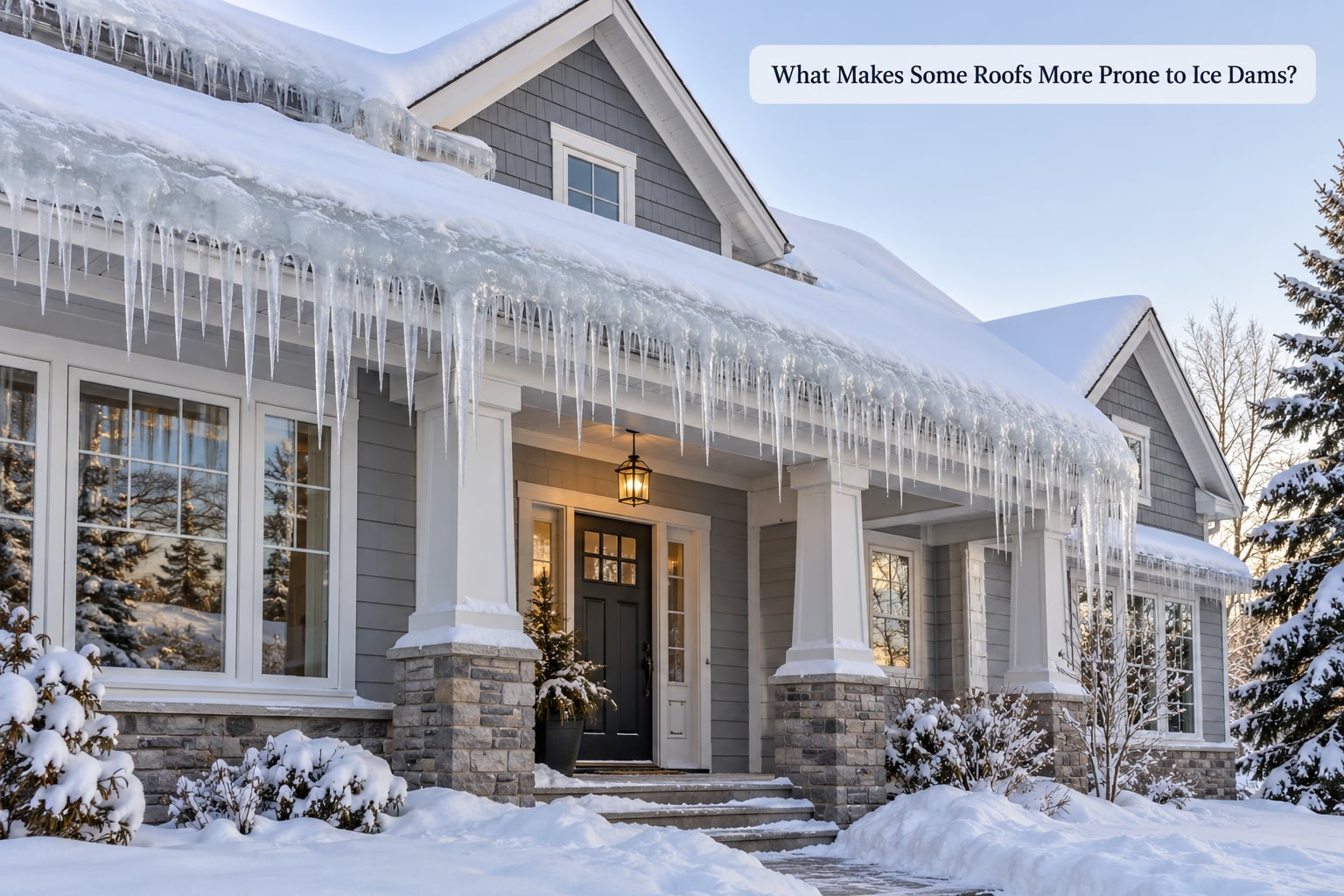
Roof design and house age decide which homes fight this problem every season and which never see it. The risk climbs with anything that puts more cold surface on the roof or lets more heat into the attic.
Wide eave overhangs are the biggest single factor because they enlarge the unheated strip of roof where meltwater refreezes. Complex rooflines do the same thing: dormers, valleys, skylights, and multiple elevations each create their own cold edges, and homeowners often rake only the most visible one.
Older homes built before airtight construction standards are usually worse off than newer ones. Without a continuous air barrier across the ceiling, the attic is effectively an unheated room connected to the living space by hundreds of small holes. Homes that were insulated before recessed lighting was common are a special case, since those fixtures vent into the attic when switched on.
Orientation matters too. North-facing slopes and elevations shaded from winter sun hold their snow longer, and shaded areas keep a colder roof surface even when the ridge is melting. A home in a heavy snowbelt with wide eaves and recessed lights is close to the worst-case combination; a steep, simple, south-facing metal roof in a milder climate is close to the best case, since a steep pitch lets snow slide off before it can trap water.
Previous damage raises the odds too. Ice-dam water that gets under shingles and into sheathing weakens the deck, and a roof that has already been patched in the same spot tends to leak there again the next winter.
How to Tell an Ice Dam from Ordinary Snow and Icicles
An ice dam is a continuous ridge of ice sitting along the eave, a few inches above the gutter line, and that ridge is what separates it from anything else. Ordinary snow sits on top of the roof and slides or waits to melt. Icicles hang from the eave, which is a sign of water running off and refreezing at the drip line, but icicles alone mean drainage is happening.
Watch for these signs from the ground, in daylight:
- A continuous band of ice across the full width of the eaves, thicker than the snow around it.
- Icicles forming in a row where there was no drip edge before, or icicles that keep growing across a warm day.
- A thick lip of ice on the gutter itself, with the gutter packed solid.
- Water stains or a bulge in the ceiling that appears during or right after a thaw, then dries out.
- Icicles forming on the inside face of the wall or hanging in a bathroom, which points to interior meltwater rather than roof runoff.
A roof viewed only from the sidewalk is genuinely hard to judge. A ladder check is not worth the risk, and an ice-covered roof is the worst possible surface for a ladder. If you cannot tell from the ground, the safest read is a roofer with proper fall protection gear.
What Damage Can an Ice Dam Cause?
The water behind the dam is the real hazard, and it starts finding paths that shingles and flashing are not designed to resist. Water sits above the shingle line, backs up under the lowest courses, and seeps through nail holes, seams, and around penetrations.
From there the damage usually runs in one direction: down. You get saturated insulation in the eave wall, wet sheathing, and then drywall stains on the ceiling or on the exterior wall below the eave. Enough water, long enough, and the wood rots. Persistent moisture in an unventilated cavity grows mold, which is a much more expensive problem than the leak itself.
The weight is the other half. A substantial dam on a long eave can add hundreds of pounds in a concentrated line, and that load pulls fasteners and deforms the gutter. Homeowners on forums also describe the sound and risk of a large block of ice letting go and dropping onto a walkway, a car, or a person below. A dam that lets go without warning is why keeping people and parked vehicles clear of the drip line matters.
Gutters and downspouts take a beating too. Ice freezes against them, the weight bends the hangers, and the downspout that would have carried the meltwater instead carried the dam.
Can You Remove an Ice Dam Safely?
You can clear ice from a dam, but clearing it does not remove the cause, and it rarely removes the whole ridge in one pass. The dam is a symptom of attic heat loss, so it regrows unless something changes upstream.
From the ground, a long-handled roof rake can pull snow off the upper slope before it melts and refreezes. The important detail most people miss: clear the entire roof, not just a strip above the dam. Partial shoveling leaves a cut in the snow pack, and meltwater then pools at that shovel line and builds a new dam right where you cut. Rakes can also catch and lift shingles or scratch granules off, so keep the rake head riding on the snow and away from the deck.
Homeowners on home improvement forums pass around a low-tech channel cutter: water in a sealed plastic bag, held against a long pole, pressed through the ridge to let the trapped water drain. It works on a thin dam. It is still a person at the eave of an iced-over roof, so the risk is the same as with a rake.
Calcium chloride in pantyhose or fabric socks hung over the ridge is the common non-powered alternative. Use calcium chloride, not rock salt. Salt corrodes gutters, downspouts, and fasteners, and it kills landscaping along the drip line once it washes down. Nothing poured on the roof and no open flame, no matter how tempting, because you are dealing with a melting stream of water on shingles and wood framing.
Steam crews are the professional answer, since they melt the dam without touching the shingles and without the salt corrosion. It costs money every year you use it. Hiring a roofer or an insulation contractor to fix the attic is what stops the recurrence. If you are about to hire either one, a duct leakage test or a home energy audit is worth having done first, because the attic work usually determines the result.
How to Prevent Ice Dams on Roofs
Prevention is an attic project wearing a roofing problem’s clothing. Work through these in order, because sealing before insulating, and fixing the air leaks before adding depth, is the sequence that holds up.
- Fix the air leaks first. Seal the attic hatch with weatherstripping and a lid you can latch or foam to the curb. Seal or replace non-IC-rated recessed lights with gasketed fixtures. Seal plumbing and wiring penetrations with fire-stop sealant or expanding foam rated for that use.
- Route the exhaust fans outside. A bathroom or kitchen fan dumping into the attic puts a surprising amount of moisture and heat into the space. Ending it in an insulated duct through the roof or an exterior gable vent is a one-duct fix that pays off every winter.
- Check the attic floor for the gaps you cannot see. Hoses to the HVAC unit, ductwork running through the attic, and duct connections themselves leak. A blower door test finds air movement no eye can catch, and an infrared camera shot on a cold night shows the warm patches. A duct leakage test sometimes turns out to be the biggest single win in the house.
- Bring the insulation up to a proper R-value. Cold-climate targets generally sit between R-30 and R-50 depending on where you live and what your local code requires. Add over the top of existing batts rather than removing them, and fill the cavities as you go if they are accessible.
- Give the attic a way to breathe. Uninsulated or partially insulated attics need soffit intake and a ridge vent, sized roughly at one square foot of free area per 300 square feet of attic floor. Blown-in or loose-fill attics that are fully insulated and air-sealed at the ceiling are a different case, and mechanical attic fans are not recommended there, since they can pull conditioned air into the attic. This is where a lot of the conflicting advice online comes from: advice written for one attic design gets applied to the other.
- Ask about open-cell spray foam carefully. It is the most effective air sealing and insulation product available, and it can be a poor fit. It has a lower R-value per inch than closed-cell foam, it can hold moisture if installed against a leaking roof deck, and it shrinks. It needs a design, a proper roof deck check, and an experienced installer, not a weekend.
- Manage the snow, not just the ice. Keep a roof rake, clear the whole slope before a predicted thaw, keep the gutters and downspouts open in the fall, and consider ice and water shield underlayment in the eaves, valleys, and around penetrations on any replacement roof.
A note on underlayment, because it gets oversold. Ice and water shield is a self-adhering membrane that resists ice penetration and wind-driven water. It reduces the damage an ice dam does. It does not stop a dam from forming, and homeowners are regularly disappointed when a leak appears anyway on a roof that has it under every course.
Heat cables and de-icing lines work by adding warmth at the eave, so they do reduce damming locally. But they only treat the cold edge, not the heat coming from the house, and they cost money to run every winter and add load to the circuit. If the attic is still leaking warm air, most homeowners who install cables end up with a lower bill and a dam that still shows up. Forum threads are full of exactly that outcome.
What Should You Do When You Notice an Ice Dam?
Work on the water first, the ice second, the cause last. A soaking ceiling will cost far more than a call to a roofer.
- Move people and possessions. Get anyone under the affected area out of the way, and move furniture, electronics, boxes, and rugs. A collapsed, water-loaded ceiling is heavier than it looks.
- Look for the slow drip first. A bucket under a small drip buys you time without anyone on the roof. Do not drill a hole in a bulging ceiling to drain it; that breaks the drywall and the wet insulation underneath can collapse.
- Document everything. Photos of the ice from the ground, the stain pattern on the ceiling, the date, the weather that caused it, and the thawing rate. That record is what your insurer will ask for later.
- Kill the heat gain where you safely can. If there is an attic access you can reach safely, sealing off or unhooking a light fixture, running a dryer or a heat gun on a timer to bring the attic temperature down, and closing doors to warm rooms all reduce melt for the day. None of that replaces the permanent fix.
- Clear the drainage path from below if you can do it safely. Break up gutter ice from a ladder only if you are trained and properly equipped, and never from the roof surface. Most of the time, the right call is to let a professional with fall protection and steam equipment handle the roof while you protect the interior.
- Call the right trade. For active water coming in, a roofer or a water mitigation company. For the recurrence, an insulation contractor or weatherization contractor who does blower door testing.
Insurance usually responds to the resulting water damage rather than to the ice itself. Damage from melting ice, and the resulting water damage, is generally covered under the dwelling portion of a standard homeowners policy, but exclusions for failure to maintain, for water that backs up through an opening you neglected, and for damage after a known leak went unaddressed are real. Read your own declarations page rather than a general article, and raise it early.
On the question of whose fault the dam is: a roofer’s workmanship can be a contributing factor. Insufficient attic insulation, an unsealed ceiling, a chimney that was never flashed, and vent or boot failures that leak in any weather are all usually treated as the homeowner’s maintenance responsibility, and a shingle manufacturer rarely covers ice-dam water that got in over an underlayment that was doing its job. Installation defects are a different category entirely, and that is the argument to have evidence for.
Frequently Asked Questions
Do ice dams mean my roof is bad?
Usually not. Most ice dams trace back to attic heat loss, not to shingle quality or roof age, and they appear on newer and older roofs alike. The exception is workmanship: a poorly flashed chimney, a failed vent boot, or a deck that was installed without proper clearance can leak in any weather. If a leak shows up during a thaw with a clear ice ridge above it, you are looking at heat loss, not a bad roof.
Should I remove ice from my roof?
Remove the snow before it melts if you can do it from the ground with a long-handled rake, and clear the entire slope rather than a strip above the dam. Partial shoveling leaves a cut where meltwater pools and a new dam forms. Do not climb onto an iced roof, use an open flame, or pour salt. A leaking, saturated ceiling is a more urgent problem than the ice.
How much attic insulation is needed to prevent ice dams?
Cold-climate guidance generally puts attic insulation at R-30 to R-50 depending on your region and local code, with higher targets in the northernmost zones. Coverage matters more than depth: even R-50 does little if warm air is moving through unsealed ceiling penetrations. Seal the hatch, penetrations, and lighting first, then add loose-fill or another layer over the top of existing batts.
Are roof gutters supposed to prevent ice dams?
No. Gutters are designed to carry water away, not to melt it or stop a dam from forming. A clogged gutter makes things worse because meltwater cannot drain and more of it refreezes, so keeping gutters and downspouts clear is worth doing. Heat cables are a different matter: they add warmth at the eave, and they can reduce damming without addressing the attic heat that causes it.
Will insurance cover damage caused by an ice dam?
Damage from an ice dam, and the water damage it causes, is generally covered under the dwelling portion of a standard homeowners policy. Adjusters look for maintenance problems, though, and policies often exclude neglect or a known defect left unrepaired. Document photos and dates at first sight, report promptly, and read your own policy language, because a standard policy still carries a dollar deductible.
Conclusion
Ice dams are almost always heat escaping from a warm living space into a cold attic, warming the roof deck until the snow above it melts, while the unheated eave overhang stays cold enough to refreeze that water into a plug. Take away any one of those three pieces and the dam cannot form, which is why the fix lives in the attic rather than on the roof.
Start from the ground and the attic access hatch. Look for the continuous ridge of ice at the eaves, note whether water is actively coming in, and look for the warm patches an infrared camera would pick up. Then close the hatch, seal the ceiling penetrations, and get a blower door test before anyone talks about new shingles. Get the interior protected first, and call a roofer or insulation contractor rather than climbing onto a frozen roof.