A MERV rating tells you how well an air filter traps airborne particles. MERV stands for Minimum Efficiency Reporting Value, it’s set by ASHRAE Standard 52.2, and it rates capture across particles from 0.3 to 10 microns on a scale of 1 to 16. Higher numbers catch finer dust, but they also fight the airflow your blower needs.
Most homeowners only need the number printed on their equipment’s spec plate, and that number is usually somewhere between 8 and 13. Everything below explains what the rest of the scale is doing, why the top of it is a bad idea in a house, and how to check what your system can actually handle before you buy a filter.
Table of Contents
- MERV Rating Explained for Home Air Filters
- What Is a MERV Rating?
- How ASHRAE Standard 52.2 Sets the Number
- Why a Higher Number Is Not Automatically Better
- Where the Scale Stops
- What Do MERV 1, 5, 8, 11, 13, and 16 Filters Capture?
- MERV 1 to 4: The Factory Screen
- MERV 5 to 8: The Standard Residential Range
- MERV 9 to 12: The Best Balance
- MERV 13 to 16: Health and Commercial Territory
- What MERV do hospitals and labs use?
- Is MERV 17 to 20 a real rating?
- How to Choose the Right MERV Rating for Your HVAC System
- What MERV can my furnace handle?
- Can You Use a Higher MERV Filter in Any HVAC System?
- Warning Signs Your MERV Is Too High
- What Counts as a Compatible Housing
- MERV Rating Versus Filter Size, Media Type, and Efficiency
- How MERV Compares to Other Rating Systems
- How to Read a Filter Label and Check Compatibility
- Frequently Asked Questions
- What MERV can my furnace handle?
- Which is better, MERV 8, 11, or 13?
- What MERV do hospitals use?
- Is MERV 13 too high for a home system?
- How often should I change my air filter?
- Does a higher MERV filter use more electricity?
- Conclusion
MERV Rating Explained for Home Air Filters
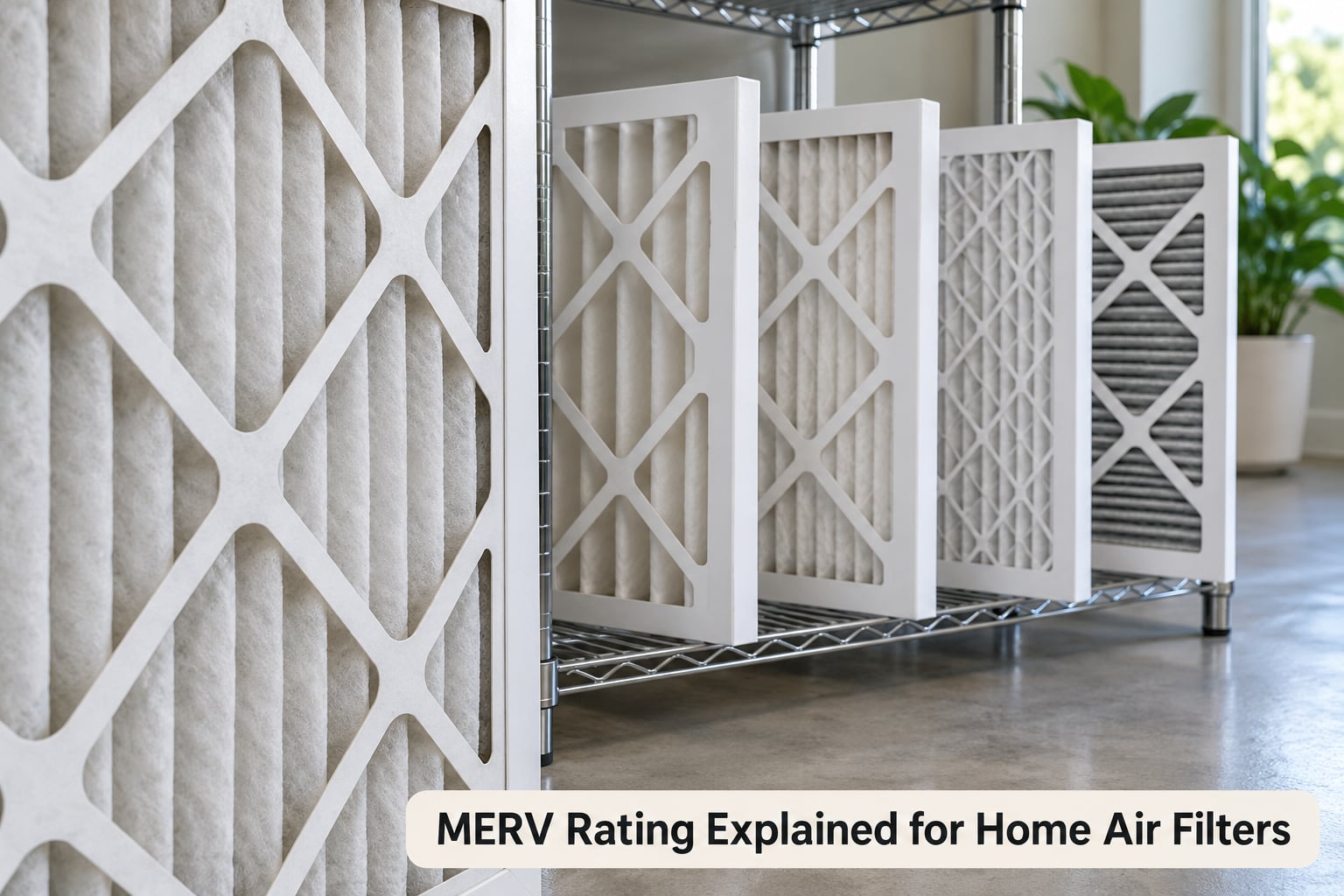
Here’s the short version. MERV rating explained in one line: it is a lab-tested efficiency number, not a quality score, and it only means something alongside the thickness of the filter and the amount of static pressure your system can push through.
The MERV rating scale runs 1 through 16. At the low end you have a flat fiberglass screen that stops carpet fibers and dust bunnies and lets almost everything else pass. At the top you have dense media that catches fine smoke and pollen, along with enough resistance to make a residential blower run hot and loud.
Key takeaways
- MERV means Minimum Efficiency Reporting Value, standardized by ASHRAE in Standard 52.2, which dates to 1987.
- The scale runs MERV 1 to MERV 16. There is no official MERV 17, 18, or 20.
- Higher MERV captures smaller particles and restricts airflow more. Those two facts never separate.
- Most residential systems are built for MERV 8 to 13. Check your spec plate before going above that.
- A 4-inch pleated filter at a higher MERV often moves more air than a 1-inch filter at a lower one.
That last point trips people up more than anything else on this page. A MERV 13 in a 4-inch cabinet is usually less restrictive than a MERV 8 in a 1-inch rack, because the deeper media gives the air room to slow down and find its way through.
On the forums, the recurring advice in r/hvacadvice leans the same way: stay at the rating in your manual, and if you want more filtration, add media depth before you add MERV. Homeowners who jumped to a high MERV in a shallow filter report cleaner air and a noticeably louder system, which is the tradeoff in one sentence.
What Is a MERV Rating?
Minimum Efficiency Reporting Value is the ASHRAE rating for how effectively a filter captures particles of different sizes. A filter is tested against a standard method, and the results across the 0.3 to 10 micron band get compressed into a single number from 1 to 16. Higher means it catches more of the small stuff.
How ASHRAE Standard 52.2 Sets the Number
Standard 52.2 is the test procedure, not the scale itself. It feeds air at a known particle concentration through the filter and measures what comes out the other side, in size bands. The efficiency figures at the larger particle sizes get combined into a composite score, and that score is the MERV number printed on the box.
This matters because it’s the only number that lets you compare a filter from one brand to a filter from another. Without it, “high efficiency” on a package means nothing.
Why a Higher Number Is Not Automatically Better
Because the same media density that traps fine particles also resists airflow. That resistance shows up as pressure drop, sometimes called static pressure, and it’s measured in inches of water column. Push it past what the system was designed for and the blower has to work harder for the same amount of air.
So a MERV rating answers one question well, which is filtration. It says nothing about whether your specific equipment can move air through that filter, and it says nothing at all about filter size. Two filters with the same MERV can behave completely differently in the same cabinet.
Where the Scale Stops
ASHRAE’s scale tops out at MERV 16. Retail packaging advertising MERV 17, 18, or 20 is using a private scale, usually one that measures a different thing under a different test, and those numbers cannot be compared to a MERV 13 from a different brand. The ASHRAE standard itself is unambiguous here: the scale ends at 16.
What Do MERV 1, 5, 8, 11, 13, and 16 Filters Capture?
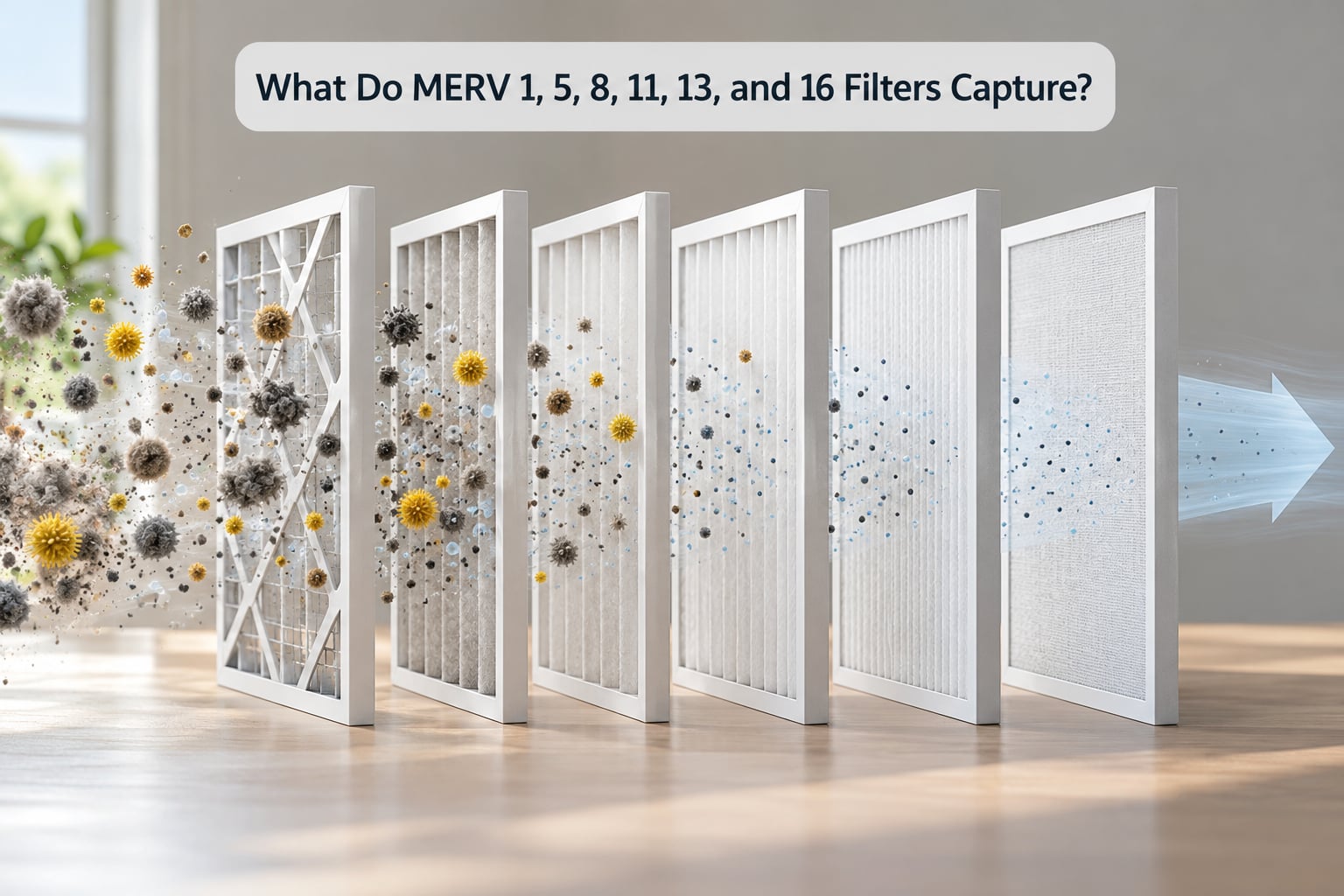
Here’s the MERV rating chart you’ll see most often. Efficiency percentages refer to particles in the 3.0 to 10.0 micron range, which is where the practical differences between residential ratings show up.
| MERV Rating | Particle Size Captured | Efficiency (3.0–10.0 microns) | What It Catches / Typical Use |
|---|---|---|---|
| MERV 1–4 | 10 microns and larger | Under 50% | Dust, carpet fibers, lint, hair. Cheap 1-inch fiberglass screens, usually the factory throwaway. |
| MERV 5–8 | 3.0 to 10 microns | 50% to 70% | Dust, pollen, mold spores, pet dander. Common residential pleated filters and the default for older systems. |
| MERV 9–12 | 1.0 to 3.0 microns | 70% to 90% | Fine pollen, fine dust, haze. Strong all-round choice for most homes with a modern system. |
| MERV 13–16 | 0.3 to 1.0 microns | 90% and above | Smoke, fine particles, leading edge of ultrafines. Needs commercial-style airflow or extra media depth. |
For scale, a human hair is around 70 microns. Dust mite debris and pollen land in the 3 to 10 micron band, which is why a MERV 8 makes such a difference in an allergy household even though it sounds unimpressive next to a MERV 13.
MERV 1 to 4: The Factory Screen
These are the flat, spun-glass filters that came in your equipment box. They exist to protect the blower wheel from large debris, not to clean your air. Almost everything under 10 microns walks right through, so a MERV 3 filter is close to doing nothing beyond catching a downed sock.
MERV 5 to 8: The Standard Residential Range
MERV 8 is the most common filter in American furnaces and air handlers, and it’s the safe default. It catches the coarse stuff that actually dirties a coil, which is the whole point of the filter, and it does it without starving the blower.
MERV 5 was the long-time default and is still what many older manuals call for. Upgrading a MERV 5 system to MERV 8 in a deeper cabinet is usually uneventful. Upgrading it to MERV 13 in the same 1-inch rack is a different question.
MERV 9 to 12: The Best Balance
MERV 11 is the rating most technicians recommend for a home, and the reasoning is simple. It moves into the 1 micron band, which matters for fine pollen and fine dust, while the pressure drop on quality media stays inside what a residential system was designed to handle.
On the forums, MERV 11 gets described the same way over and over: the point where filtration improves noticeably and the system has no idea anything changed. If your system takes a 4-inch filter, MERV 11 in that filter is the low-drama upgrade.
MERV 13 to 16: Health and Commercial Territory
MERV 13 is where the EPA’s guidance points homeowners who want a meaningful indoor air quality improvement. It captures 90% or more of 3 micron particles, which includes leading-edge smoke and fine haze. It is not free, but on a modern system with a deep filter cabinet, it’s a reasonable ask.
MERV 14 through 16 are commercial and light-commercial ratings. They exist for systems with large blowers, high static pressure capacity, and filter racks built for that media. Dropping a MERV 16 into a residential 20x25x1 slot is the single most common way people damage their own system.
What MERV do hospitals and labs use?
Hospitals generally don’t rely on the MERV scale at all. Operating rooms, isolation rooms, and labs use HEPA-type filtration rated at 99.97% capture of 0.3 micron particles, often as a final stage after a MERV 13 to 16 pre-filter that protects the expensive units. That requires dedicated air handlers, sealed housings, and verification the system was never designed to deliver. No home HVAC system is built for it, and no home replacement filter is a HEPA filter.
Is MERV 17 to 20 a real rating?
No. ASHRAE Standard 52.2 defines MERV 1 through MERV 16, and that is the ceiling. A package claiming MERV 18 or MERV 20 is usually reporting a percentage of particles removed at a single size, or a proprietary brand scale, not a MERV value. Judge those filters by MERV alone and you’ll compare a number to a number that means something else entirely.
How to Choose the Right MERV Rating for Your HVAC System
Start with the highest number your documentation allows and work down only if you have a reason. The usual order of operations looks like this.
- Read the spec plate or manual. Most furnaces and air handlers list a maximum filter MERV, often 8 or 12. Some manuals are vague, which is common on older residential equipment.
- Check how much depth your cabinet gives you. A 1-inch slot changes the answer completely compared to a 4-inch rack, even at the same MERV.
- Look at the return and supply ducts. Older homes with undersized or flex duct have less margin, because every bit of extra restriction shows up as uneven airflow between rooms.
- Match the rating to the household. A house with two shedding pets, an asthma diagnosis, or a wildfire season nearby has more reason to push upward than a house with none of those.
- Budget for the replacement interval. A higher MERV clogs faster. In a 1-inch rack that means more visits; in a 4-inch rack, fewer.
What MERV can my furnace handle?
Three routes answer that, and the first two are free. First, check the manufacturer’s literature or the spec plate inside the filter compartment. Second, find the model number and call the manufacturer’s service line, where they can look up the design filter specification in seconds. Third, if you want a real number, have a technician measure the system’s external static pressure with the filter installed and compare it to what the manual says the system should read.
Static pressure, in plain terms, is the resistance the fan is pushing against. A system designed for a particular filter has a normal operating range, commonly around 0.5 to 0.8 inches of water column for many residential installations. A reading well above that with a fresh filter in place is the honest answer to whether that MERV belongs in your system.
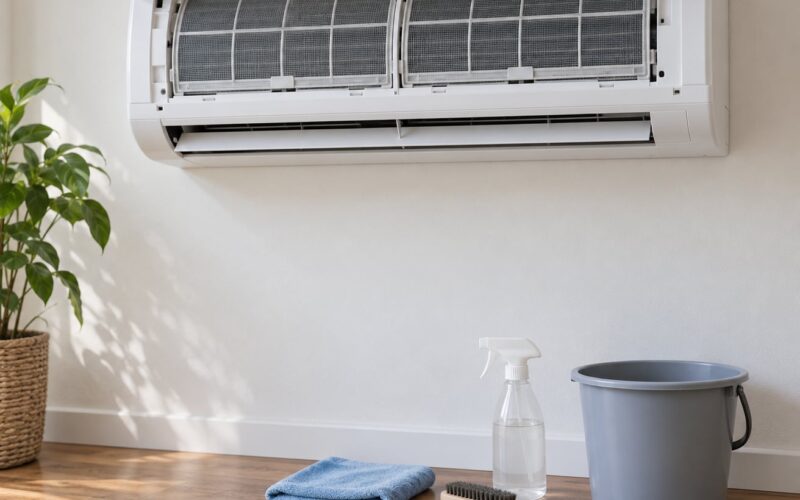
Window and portable air conditioners are a different case entirely. They usually ship with a thin washable mesh screen, and putting a high MERV cartridge in a portable unit just starves the fan. Ductless mini-splits use washable filters in the indoor head that you rinse, and the filtration there is whatever the manufacturer built in, not a MERV number you can change.
Can You Use a Higher MERV Filter in Any HVAC System?
No, and the reason is pressure drop. Denser media means more resistance, which means the blower delivers less air at the same fan speed. A system that can’t push its design airflow loses heat in winter and gets warm in summer, and the compressor can cut cycles short on a high-MERV clogged filter, which shows up as ice on the outdoor coil.
Warning Signs Your MERV Is Too High
- Weak or noticeably reduced airflow at registers after a filter change.
- New whistling, rumbling, or a high-pitched whine that wasn’t there before.
- Rooms that heat up faster or cool down slower than the rest of the house.
- Runs that stretch much longer, or a system that no longer reaches set temperature on a mild day.
- Ice or frost forming on the indoor coil or outdoor coil in cooling season.
- An energy bill that climbed without any change in how the house is used.
- Early signs of blower wear, noise from the motor housing, or a motor running hotter than it used to.
Any one of those, appearing right after a filter upgrade, is a reason to go back to the previous rating. Several of them together mean something is genuinely wrong and a technician should look at it.
What Counts as a Compatible Housing
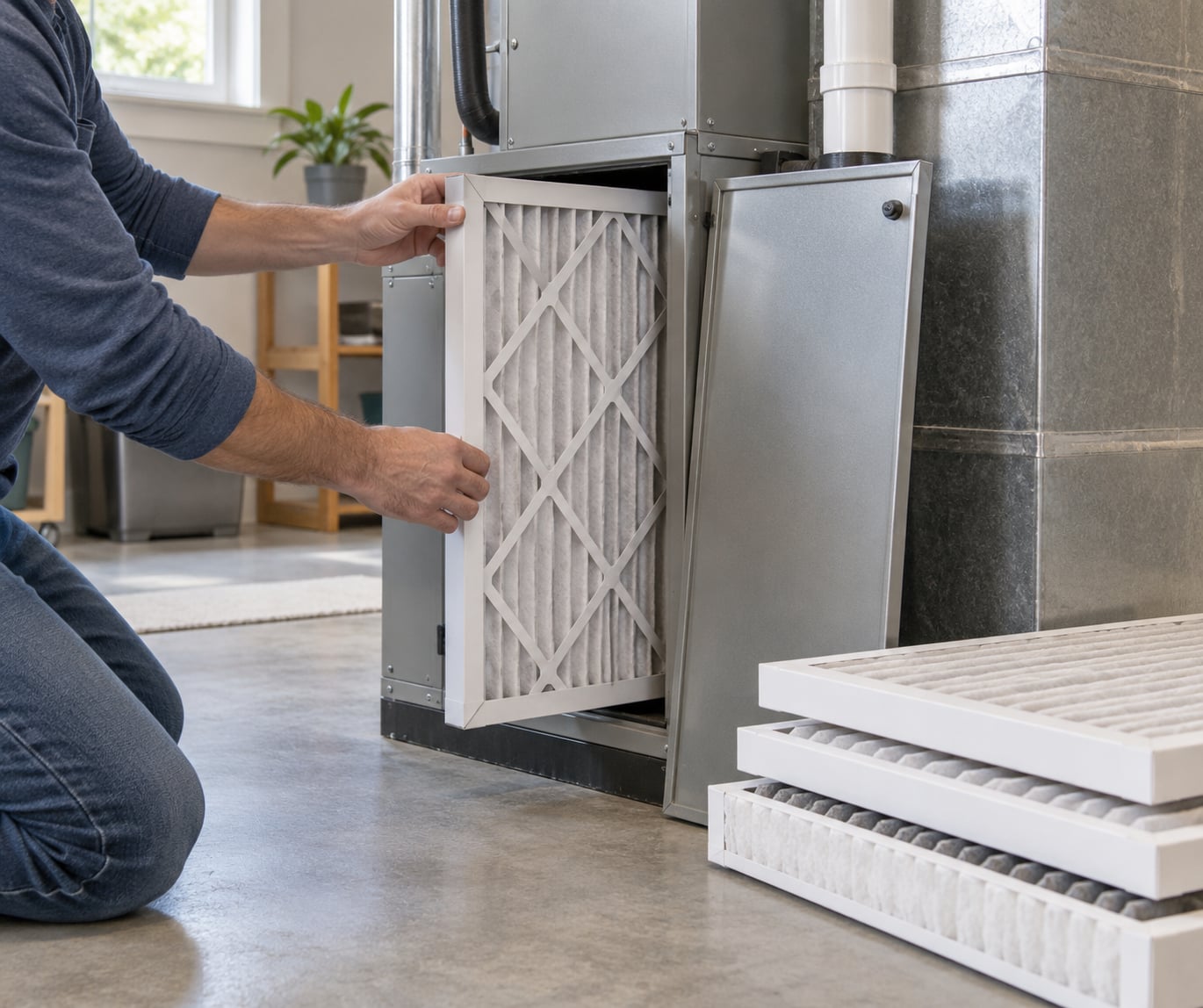
Filters need to fit the slot snugly, and the frame needs to seal. Gaps let unfiltered air bypass the media entirely, which means you paid for filtration you didn’t get. Sealed pleated cabinets with a gasket around the door do the best job, which is one reason upgrading the housing can be worth more than upgrading the filter.
Then there’s the manual. Manufacturer instructions on filter selection and thickness are the authority here, and they are also the document a technician will quote if something fails. If your manual says MERV 8, match MERV 8 and see your equipment dealer if you need more filtration than that allows.
MERV Rating Versus Filter Size, Media Type, and Efficiency
This is where most buying mistakes happen. People treat MERV as the only variable when media type and depth change the result just as much.
| Filter Type | Typical MERV Range | Maintenance | Best For |
|---|---|---|---|
| Flat fiberglass, 1 inch | 1–4 | Replace monthly or when grimy | Protecting the blower from debris on a budget |
| Washable metal mesh or plastic | Not rated | Rinse every 30 to 60 days, let dry fully | Households that refuse to buy disposables |
| Pleated polyester, 1 inch | 5–8 | Replace every 30 to 60 days | Standard systems, mild climates |
| Pleated media, 2 inch | 8–11 | Replace every 60 to 90 days | Cabinets with a 2-inch slot |
| Deep pleated media, 4 inch | 8–13 | Replace every 90 to 180 days | Higher MERV without choking airflow |
| Electrostatic | Often 11–13 | Washable, needs a replacement pre-filter | Homes wanting depth without frequent disposal |
Depth is the underrated lever. A 4-inch pleated filter at MERV 13 typically holds more dirt before it starts to restrict air than a 1-inch MERV 8 does, so you get finer filtration and fewer replacement runs at the same time.
| Filter Depth | Typical MERV Achievable | Filters Needed Per Year |
|---|---|---|
| 1 inch | 5–8 | 6 to 12 |
| 2 inch | 8–11 | 4 to 6 |
| 4 inch | 8–13 | 2 to 4 |
Homeowners debating the upgrade from a 1-inch MERV 8 to a 4-inch MERV 13 usually find the running cost flattens out, because four 4-inch filters a year cost about what twelve 1-inch filters do, and the equipment sees less pressure drop.
How MERV Compares to Other Rating Systems
HEPA is a different standard entirely, measured at 99.97% removal of 0.3 micron particles, and it isn’t available as a home ducted filter. MPR and FPR are proprietary scales from specific brands that aren’t interchangeable with MERV, though they often look deliberately similar on the shelf. An electrostatic filter charges particles as air passes, so it captures more with less resistance and needs washing instead of disposal. When a package leads with any of these instead of a MERV number, find the ASHRAE 52.2 figure underneath it.
How to Read a Filter Label and Check Compatibility
Every replacement filter frame carries the information you need, usually printed on the edge you can read before sliding it in.
- Nominal dimensions. 20x25x1 is a 20 by 25 inch face at 1 inch deep. Measure your cabinet slot, not the old filter, since old filters relax over time.
- The MERV rating. Check whether it’s an ASHRAE 52.2 figure or a brand-specific claim, and treat anything above 16 as brand-specific.
- The airflow arrow. Most frames have an arrow printed on the side. It points toward the blower, which is normally toward the furnace, not toward the ducts. Getting this backwards is common in a tight attic install.
- Manufacturer warnings. Read the maximum MERV the frame is rated for. A 1-inch frame is rarely rated above MERV 8 no matter what the cardboard sleeve says.
- Install date. A pen mark on the frame or the housing door is the cheapest reminder system you’ll ever install.
If the frame is a different shape than the slot, don’t force it. A filter that has to be folded, trimmed, or wedged will leak air around itself, and you’ll pay for filtration you don’t receive.
Frequently Asked Questions
What MERV can my furnace handle?
Most residential furnaces and air handlers are rated for MERV 8 to 13, with older and smaller systems often capped at MERV 8. Check the spec plate in the filter compartment or the manual first. If neither states a limit, call the manufacturer with your model number. A technician can also measure external static pressure with the filter installed and compare it to the manual’s range.
Which is better, MERV 8, 11, or 13?
MERV 8 is the safe default for older equipment and shallow 1-inch filter slots. MERV 11 is the best balance for most modern homes, adding 1 micron filtration with little extra restriction in a deeper cabinet. MERV 13 makes sense when someone in the house has allergies or asthma, or during heavy smoke seasons, provided your system can move the air.
What MERV do hospitals use?
Hospitals usually skip the MERV scale for their critical spaces and use HEPA-type filtration rated at 99.97% capture of 0.3 micron particles, often paired with a MERV 13 to 16 pre-filter. That setup needs dedicated air handlers and verified system design, so it has no equivalent in a residential system. Home filters rated MERV 16 are commercial media, not hospital grade.
Is MERV 13 too high for a home system?
On a modern system with a 4-inch filter cabinet, MERV 13 is usually fine. In a 1-inch slot on an older unit, it can restrict airflow enough to shorten run times, warm the house, and strain the blower. The rating is not too high in general, only too high for that housing and that equipment. Match the depth first, then raise the MERV.
How often should I change my air filter?
A 1-inch filter generally needs replacing every 30 to 60 days, a 2-inch filter every 60 to 90 days, and a 4-inch filter every 90 to 180 days. High MERV ratings clog faster because they hold more fine dust. Check it monthly rather than trusting the calendar, especially during wildfire smoke, construction nearby, or a dusty season.
Does a higher MERV filter use more electricity?
It can, indirectly. A restrictive filter forces the blower to run longer to move the same amount of air, and a system that can’t keep up may short-cycle, which costs more. A deep filter at a higher MERV usually avoids the penalty, since the extra media depth offsets the finer capture. Cleaner coils help too, because a dirty coil restricts airflow on its own.
Conclusion
Start at the filter housing. Read the spec plate or the manual for the maximum MERV your equipment was designed for, then check how much depth your cabinet gives you. Buy the highest rating that fits that limit, keep the frame sealed and the arrow pointed toward the blower, and change it on a schedule that matches its thickness.
If airflow dropped after a swap, go back one rating and recheck. A house that breathes properly is worth more than a filter that catches one extra fraction of a micron.