If you are weighing a whole house humidifier vs portable unit, the short version is simple. If you own a forced-air furnace and a water line and the dryness reaches every room, a whole house humidifier is the better buy. If you rent, need help in one room, or just want to test whether humidity is really your problem, a portable unit is the smarter move. Here is how the two compare on the things that actually decide it.
Table of Contents
- Whole House Humidifier vs Portable at a Glance
- How Each Humidifier Type Works
- Why Ultrasonic Units Make White Dust
- Humidity Coverage and Control
- Whole House Humidifier vs Portable Humidifier: Coverage
- Installation and HVAC Compatibility
- Maintenance, Cleaning, and Water Requirements
- Portability and Room-by-Room Use
- Noise, Energy Use, and Daily Convenience
- Upfront Cost and Total Ownership
- Which Should You Choose?
- Frequently Asked Questions
- Is a whole-house or portable humidifier better?
- Do I need a whole-house humidifier if I have an HVAC system?
- Can a portable humidifier work on hardwood floors?
- What indoor humidity level should I aim for?
- Are portable humidifiers better for renters?
- Conclusion
Whole House Humidifier vs Portable at a Glance
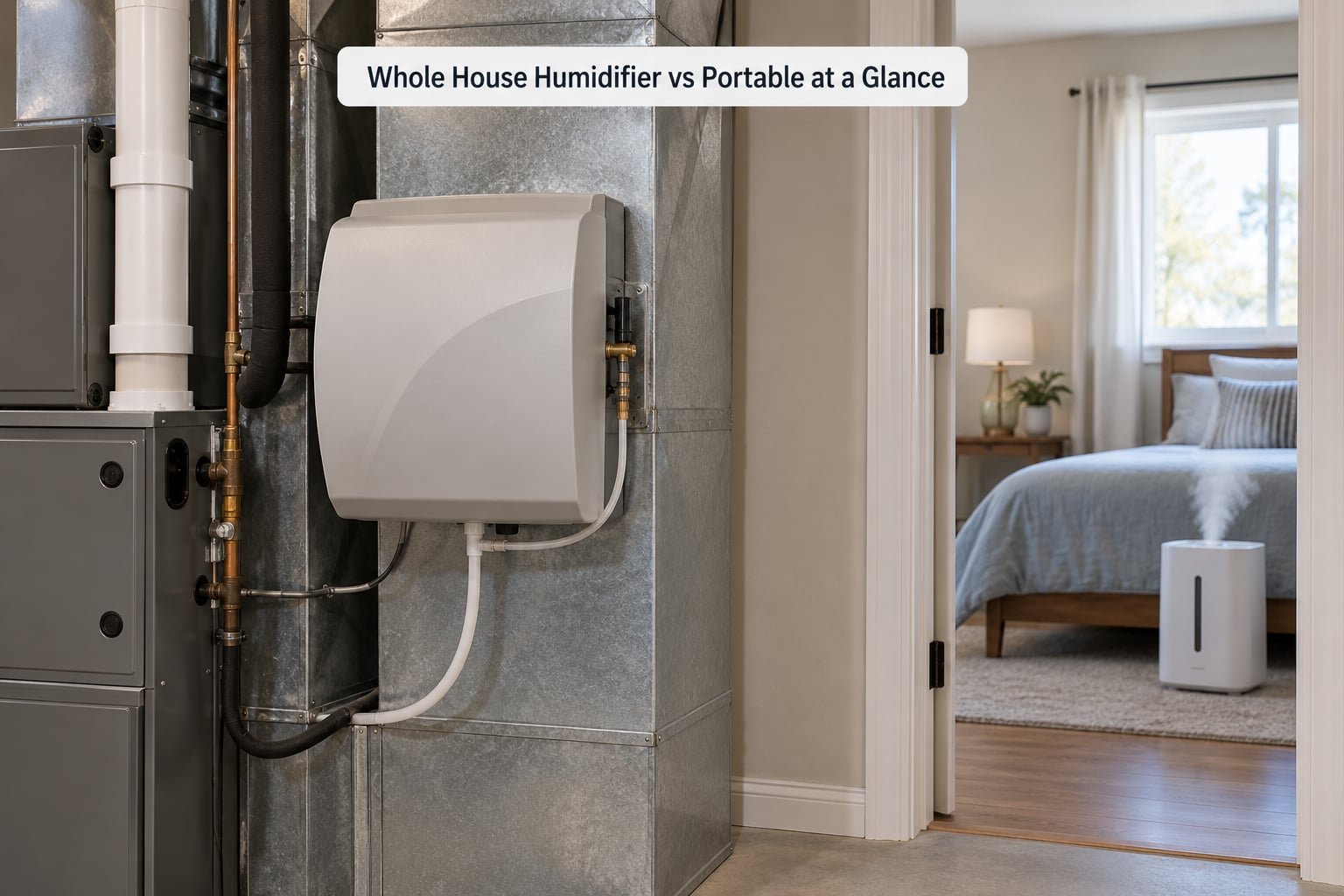
The honest summary: whole house humidifier vs portable comes down to coverage and commitment. A ducted system treats every space your air distribution reaches and runs on a set point. A portable unit treats the room it stands in, and you manage it by hand.
| Factor | Whole house humidifier | Portable humidifier |
|---|---|---|
| Room coverage | Every room on the duct system, including upstairs floors | One room; realistically one to two adjacent rooms in mild weather |
| Installation | Duct modification, water line, drain and control wiring by an HVAC professional | Unbox, fill, plug in, place |
| Water supply | Plumbed line with an automatic feed | Tank you refill by hand, often daily in winter |
| Humidity control | Humidistat plus inline sensor, runs only when air falls below the set point | Manual dial or built-in humidistat on larger units; you set the level |
| Maintenance | Pad or filter change once or twice a season, annual service | Empty and clean weekly, replace filters or wicks on a schedule |
| White dust risk | Very low with an evaporative pad | Low with evaporative or steam; noticeable with ultrasonic and hard tap water |
| Noise | Mostly the furnace fan, which is already running | Audible fan or a hiss from a misting unit, audible in a quiet bedroom |
| Best suited for | Multi-level homes, hardwood floors, wood furniture, open-plan living space | Renters, single bedrooms, nurseries, home offices, mild climates |
How Each Humidifier Type Works
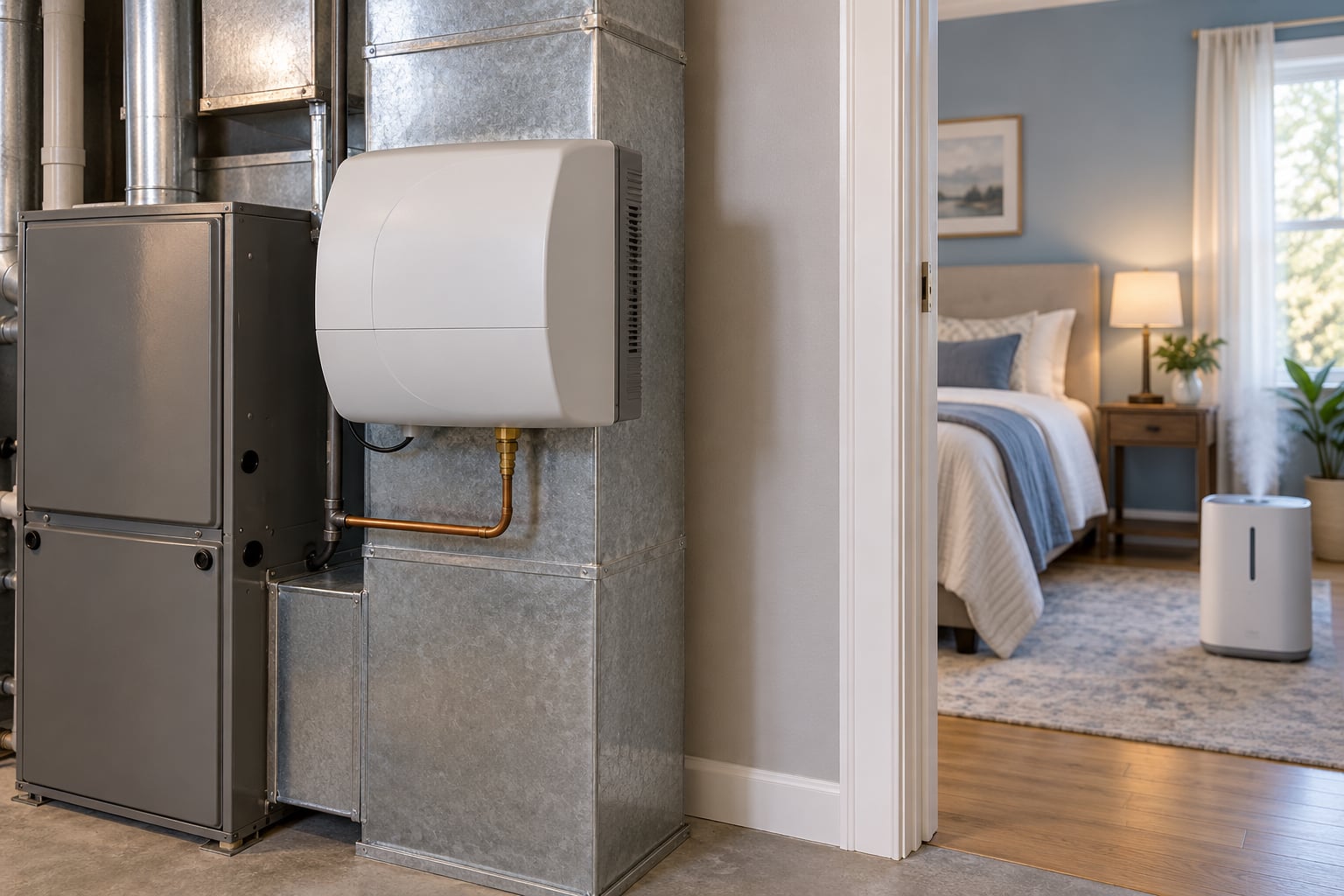
A whole house humidifier bolts onto the supply side of your furnace, usually on the horizontal plenum just after the blower. It pulls water from a plumbed line, runs it across an evaporative pad, and the furnace air carries that moisture into every duct. A humidistat and an inline humidity sensor read the air and shut the water off when your set point is met.
Portable units come in three common types. Evaporative units use a fan to pull air through a wet wick, and what escapes into the room is humid air minus the minerals that stayed behind. Ultrasonic units shake water into a fine cool mist with high-frequency vibration. Steam units heat water to boiling and release a warm mist, which puts the least amount of mineral into the air of the three.
Why Ultrasonic Units Make White Dust
The white dust people complain about is not mold and it is not the fan shaking dust off a shelf. It is the mineral content of your tap water, calcium and magnesium, being atomized along with the water and deposited on every nearby surface as a fine powder. Hard water areas produce it fastest. Users on r/homeassistant traced their own dust problem back to hard water rather than a faulty unit, which matches what the physics predicts.
So the type of portable humidifier matters more than most buying guides admit. Evaporative and steam models leave minerals in the tank or the wick, and evaporative models are quieter than steam. A forum thread on r/milaair referenced a case report linking heavy white dust exposure to a lung injury in a child, which turns a cosmetic annoyance into something worth taking seriously in a nursery or a bedroom.
Humidity Coverage and Control
Winter air is dry for a simple reason: cold outdoor air holds very little moisture, and heating it indoors lowers the relative humidity further. Most HVAC guidance puts a healthy indoor range at 30 to 50 percent, with 30 to 40 percent a practical winter target before you start seeing condensation. Below roughly 30 percent, dry skin, static shocks, chapped lips and irritated sinuses get common, and hardwood floors and trim start losing moisture.
A portable humidifier drops the reading in its own space and does very little beyond it. Put one in a bedroom and the living room stays where it was. Put one near an open doorway in winter and it will help the adjacent room, but the effect fades a few feet out. On r/hvacadvice, people describe running two portables in the family room and the bedroom rather than installing anything, which is a reasonable middle path for a smaller house.
Whole House Humidifier vs Portable Humidifier: Coverage
A portable model treats the area around it, while a whole-house system supports consistent humidity across the entire connected duct system, including the upstairs bedrooms that a portable never reaches. That is the core coverage difference, and it is why whole-house wins in a multi-level home and loses in a small one.
There is a middle option forum users point to that most articles skip: a large-capacity portable rated around two gallons per day. It will humidify a big open living room or a main floor in a mild climate, without a furnace tie-in. It is still a device you refill and move, but it bridges the gap between a bedroom unit and a full install.
Installation and HVAC Compatibility
A portable humidifier needs a flat surface, an outlet and a water source. That is the whole setup, and you can move it between rooms as the season changes.
A whole house humidifier needs a forced-air HVAC system with a supply plenum, a plumbed water line with a shutoff valve and drain, and low-voltage control wiring. It is not a weekend project for most people. Duct modifications and refrigerant or electrical work belong to a licensed HVAC professional, and mixing water and electricity inside a heating system is exactly the kind of job worth hiring out.
Talk to a contractor before buying anything. Ask what tonnage your furnace is, whether the plenum has room for the unit and a bypass valve, and where the drain line can go. Ask them to size the output to your square footage and climate, not to the largest model they stock. Undersized units run constantly and wear out early.
Renters, and owners of apartments with no furnace and no water line, are out of luck on the installed option entirely. That is where a portable unit is not a compromise but the only practical answer.
Maintenance, Cleaning, and Water Requirements
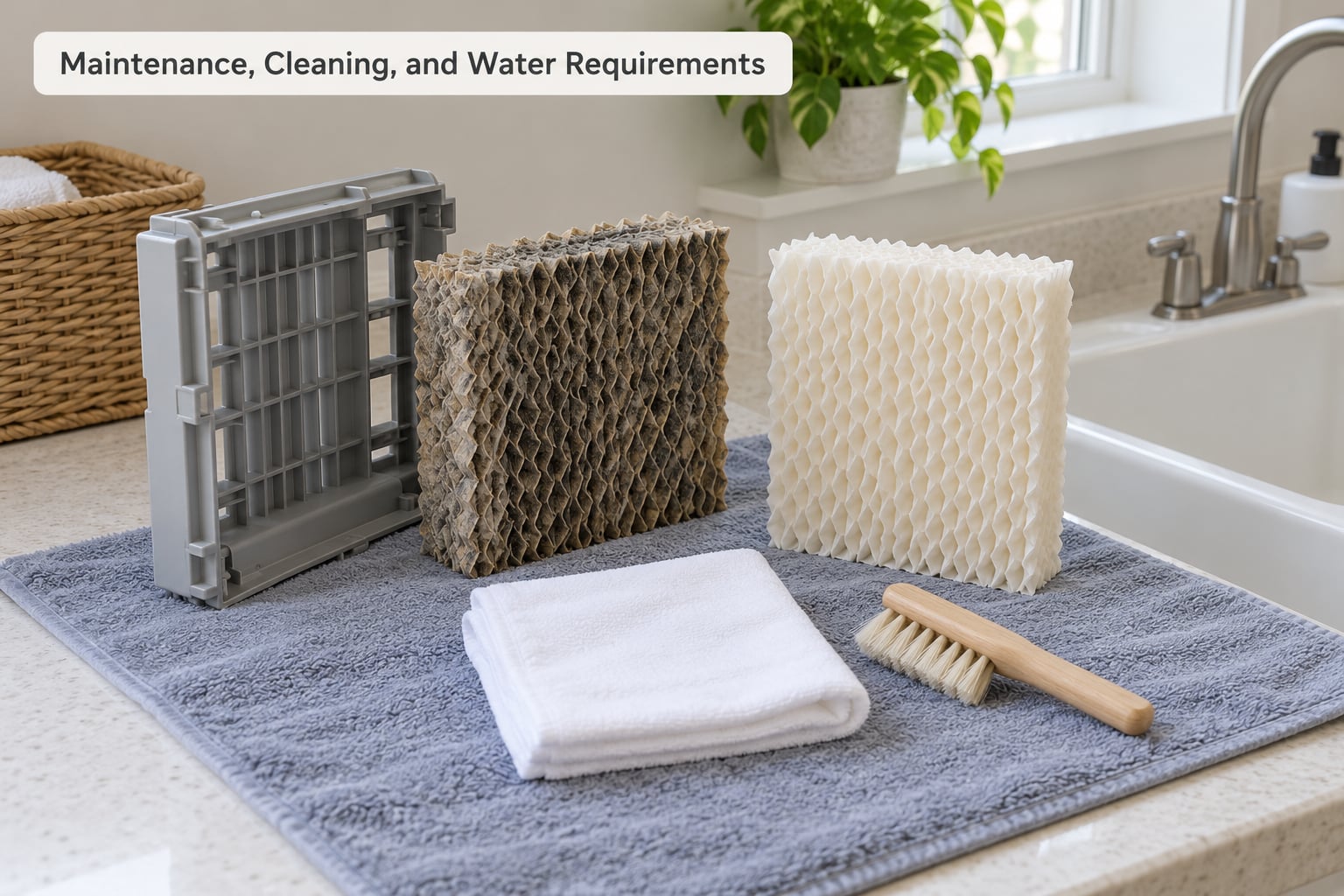
Portable units demand attention on a weekly rhythm. Empty the tank, wipe the base, rinse the wick or filter, and let parts dry before reassembly. Standing water and biofilm are what turn a humidifier into a microbial source, and a humidifier that is not cleaned on schedule can push aerosolized bacteria into a room. Follow the manufacturer’s cleaning interval and use the water type specified in the manual. Using distilled or demineralized water reduces mineral scale and dust, though it adds a step nobody enjoys at 6 a.m.
Whole house units trade daily work for occasional work. Water is plumbed in, so there is no refilling, and the unit shuts itself off at the set point. The maintenance items are the evaporative pad, called a media filter, which typically needs changing once or twice a heating season, and an annual inspection that usually happens during a furnace tune-up. Scale is less of an issue because the water never sits in an open tank.
One practical warning from the HVAC side: a humidifier can hide air leaks in older homes. Adding moisture to leaky ductwork makes the system run longer and can mask a bigger envelope problem. If your furnace has static pressure or filter issues, address those first.
Portability and Room-by-Room Use
Portability is the one category where portable units win outright, and it matters more than it sounds. A nursery, a home office and a bedroom can each get a targeted unit while you learn which room actually causes the complaints. Seasonal relocation is easy, and a unit can come with you to a rental, a guest room or a short-term stay.
Whole-house systems cannot serve a space outside the duct distribution, and that includes garages, basements with no supply vent, and additions added after the system was installed. If you have one of those dry rooms, you add a portable unit regardless of what is mounted on the furnace. This is also the most common version of the mixed approach: a whole-house system handling the main living space, plus a small portable for a bedroom or nursery where you want a tighter, independently controlled number.
Noise, Energy Use, and Daily Convenience
A portable humidifier adds a new sound to a room. Evaporative models run a modest fan, ultrasonic units add a faint high-pitched whine, and steam units hiss continuously. In a quiet bedroom at night, that is a real tradeoff for better air.
A ducted humidifier is nearly silent because the sound you hear is the furnace fan, which is already running whenever the heat is on. The system also uses less electricity than you might expect, since the primary load is the water pump and a small fan, and the furnace’s existing blower does the distribution.
Convenience is the bigger daily difference. Managing one appliance is a ten-minute habit. Maintaining a whole-home system means setting a number once and mostly forgetting it, which is the honest core of why owners who install one rarely go back. It also means the humidity stays steady while the weather swings, instead of drifting up on a mild afternoon because nobody turned the dial down.
Upfront Cost and Total Ownership
Prices for both options vary widely by region, by home size and by brand, and they change over time, so treat any figure you see as a starting point and get written quotes for your specific situation.
The installed option is a project. The unit itself is the smaller share of what you pay, and the drain line, control wiring, any plenum modifications, and possibly a water line extension drive the rest. Running a second portable unit for years adds up differently: replacement filters or wicks, the electricity for the fan, and the cost of whatever water you use.
Ongoing ownership flips the comparison. A whole house system costs you pads, a service visit, and a modest increase in water use. Portable units cost you consumables and your attention, and in a large home you may need several of them running at once to match what one ducted system does, plus the water and power for all of them.
The break-even point depends almost entirely on how many rooms you are trying to treat. For a single bedroom, the portable option wins on both the purchase and the running side. For a two-story house that feels dry everywhere, the installed system usually wins after the first couple of winters, and it wins more clearly the more rooms you would otherwise cover with separate devices.
One cost people forget: a unit you are constantly refilling is not free just because you bought it once. The most expensive part of a portable humidifier is usually the habit around it.
Which Should You Choose?
Choose a portable humidifier if you rent, if the dryness is confined to one room, if you have no forced-air furnace or no water line, if you live in a mild or humid climate, or if you want to find out whether humidity is even the problem before committing to anything. Add a second unit for a nursery or an office if you have two problem rooms.
Choose a whole house humidifier if you have a forced-air furnace and a water line, if the dryness affects multiple floors, if you have hardwood floors or solid wood furniture that is shrinking and cracking, if you are tired of managing devices, and if you want one set point instead of a dozen dials. Have it sized and installed by a licensed HVAC professional, ideally during a furnace tune-up.
Choose neither yet if your home reads comfortably in range through winter. Check with a hygrometer first. A fifty-dollar hygrometer or a cheap sensor on your home automation dashboard will tell you in a week what a sales conversation will not. If your home sits between 30 and 50 percent, an installed system solves a problem you do not have, and adding moisture only moves you toward condensation and mold risk.
Frequently Asked Questions
Is a whole-house or portable humidifier better?
It depends on how many rooms are dry. A portable humidifier is better for a single room, for renters, and for homes without a forced-air furnace or water line. A whole-house system is better when several floors feel dry and you want one set point instead of daily refills. Measure first: if one hygrometer in the coldest room reads 30 to 50 percent, you probably do not need a system.
Do I need a whole-house humidifier if I have an HVAC system?
Having HVAC makes a whole-house humidifier possible, not mandatory. A furnace with a supply plenum, a water line and a drain is the requirement. Decide based on readings, not on the fact that a furnace exists. Houses in humid climates with a tight envelope often need nothing, and a portable unit handles a single bedroom perfectly well.
Can a portable humidifier work on hardwood floors?
Yes, with care. Keep the unit on a waterproof mat or tray, set it a few feet off bare wood, and aim for a moderate humidity setting rather than maximum. Rapid swings in relative humidity cause wood to swell and shrink, which is what leads to cupping, gaps and cracked finish. Setting a hygrometer in the room and holding a steady number matters more than any single device.
What indoor humidity level should I aim for?
Most guidance points to 30 to 50 percent relative humidity year round, with 30 to 40 percent a sensible winter target. Below 30 percent, dry skin, static electricity, nosebleeds and irritated sinuses become common, and wood starts losing moisture. Above roughly 60 percent you invite condensation on windows, wall surfaces and ductwork, which is where mold risk begins.
Are portable humidifiers better for renters?
They are usually the only realistic option. Renters rarely have a water line, a plenum or permission to modify ductwork, and a portable unit can be carried between rooms or removed entirely at move-out. Two small units in the rooms that bother you most will outperform one unit you are trying to make cover a whole apartment. Clean them weekly and you will avoid mold problems.
Conclusion
In a whole house humidifier vs portable decision, four things settle it, and you can check all of them before spending money. Put a hygrometer in the coldest room for a week. Measure the space you actually need to treat, not the square footage on the listing. Decide how much weekly maintenance you honestly want to own. Then check whether your forced-air furnace has a plenum, a water line and a drain.
If humidity reads low on every floor and the furnace is ready, a whole house humidifier solves the problem once and holds a steady number. If the problem is one room, or you rent, or you have no furnace, a portable unit does the same job for far less, as long as you refill and clean it. For personal health questions about dry air or allergies, talk to your doctor; for sizing and installation, talk to a licensed HVAC contractor.