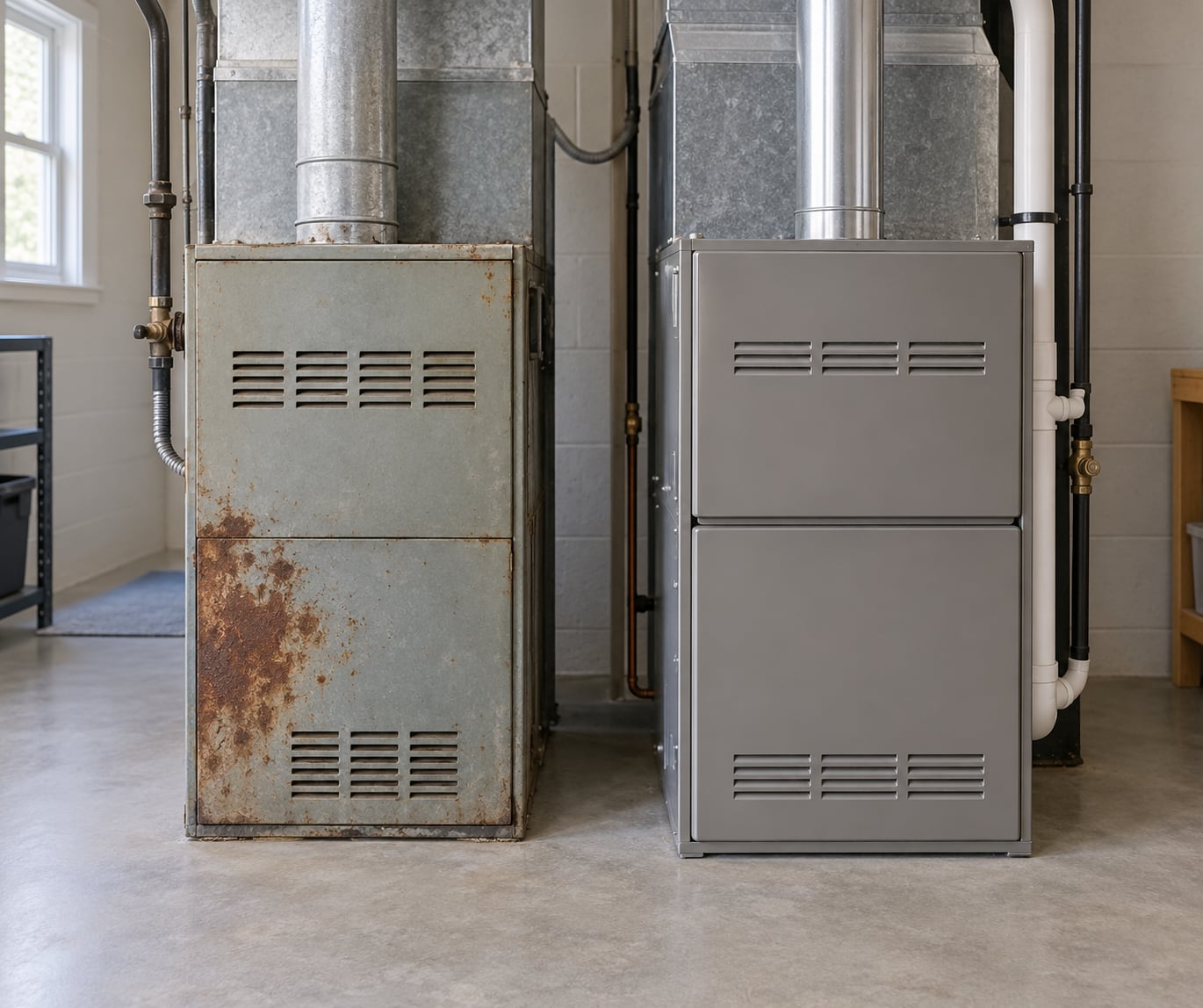
Most homeowners should repair a furnace that is under about 12 years old with a minor fault, and replace one that is 15 years or older with a major component failure. When to replace vs repair your furnace usually comes down to two numbers: if the repair lands at half the price of a new furnace, or if the furnace’s age multiplied by the repair bill comes out above 5,000 dollars, replacement is the better investment.
Neither number decides it alone. A healthy 20-year-old unit that has never missed a beat is a different case from a 9-year-old furnace that has failed three times since last fall. This guide walks through age, cost, failure history, efficiency and safety so you can tell which furnace you own.
Table of Contents
- When to Replace vs Repair Your Furnace at a Glance
- How Old Is Your Furnace?
- What Does Repair Cost Compared With Replacement?
- How Often Has Your Furnace Failed?
- Is Your Furnace Still Efficient and Safe?
- What Signs Mean You Need a Furnace Repair?
- What Signs Mean It Is Time for Furnace Replacement?
- What Should You Ask an HVAC Contractor?
- How to Choose Between Furnace Repair and Replacement
- When to Replace vs Repair Your Furnace: Which Option Wins?
- Frequently Asked Questions
- How old is too old to repair a furnace?
- Is it worth repairing a 20-year-old furnace?
- What does a furnace repair typically cost?
- What furnace problems require immediate attention?
- Should I repair my furnace or replace it with a heat pump?
- Does a furnace warranty cover the blower motor or heat exchanger?
- Conclusion
When to Replace vs Repair Your Furnace at a Glance
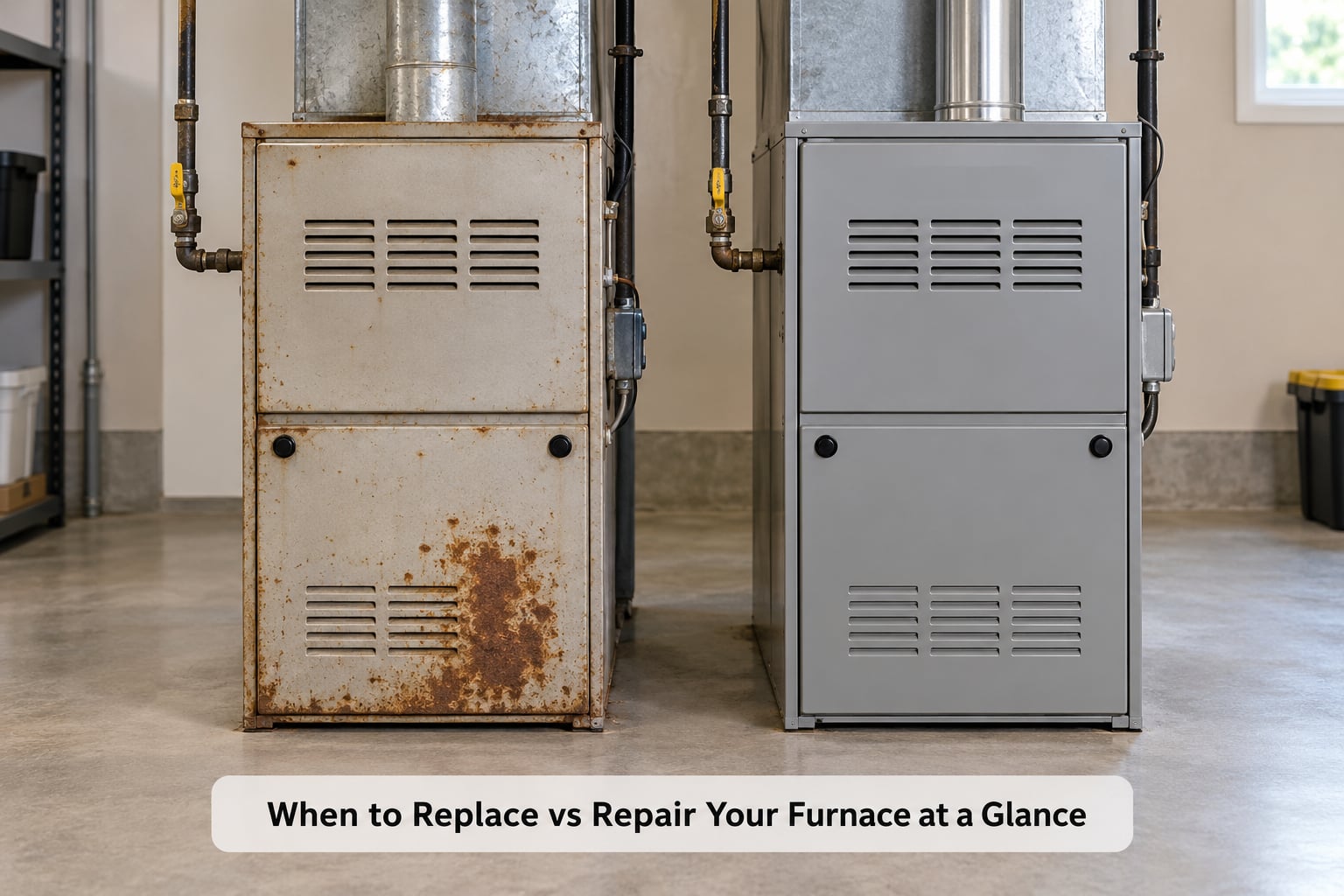
Start with the table below. If your situation matches the third column on any safety or cost line, replacement wins regardless of how young the furnace is.
| Factor | Repair makes more sense | Replacement makes more sense |
|---|---|---|
| Age | Under 12 years | 15 years or older |
| The fault | One minor part: filter, thermostat, igniter, flame sensor, limit switch | Major component: heat exchanger crack or blower motor |
| Cost of repair | Well under half of a new system’s price | Half or more of a new system’s price |
| Failure history | One isolated breakdown | Several breakdowns in one heating season |
| Efficiency | Annual fuel utilization efficiency holds steady and bills are flat | Old 60 to 70 percent unit replaced by a 90 to 95 percent model |
| Safety | No combustion or vent problems | Carbon monoxide, yellow flame, cracked heat exchanger |
| Warranty | Parts and labor still covered | Expired or parts are no longer stocked |
| Your plans | Selling or moving within a few years | Staying in the home for a decade or more |
Read the age row as a starting point, not a command. Plenty of 22-year-old furnaces still heat a house fine, and plenty of 8-year-old units are already rusting from the inside out.
How Old Is Your Furnace?
Furnaces typically last 15 to 20 years. Gas furnaces usually run 12 to 20 years, electric models often reach 20 to 30, and heat pumps vary with climate and how hard they work. That range assumes annual maintenance and a reasonably clean installation.
To find your number, look on the nameplate or data sticker on the side of the cabinet or the door frame. The serial number often encodes the month and year. If the sticker is gone or painted over, the service records from previous visits are the next best evidence, and if neither exists you are guessing.
That guessing is why age alone makes a weak case. An unmaintained 12-year-old furnace can have more life left in it than a carefully serviced 17-year-old one. Homeowners on r/homeowners often describe exactly this situation, an old unit that still runs well, and the consensus advice there is to keep it running as long as it heats the house and the repairs stay reasonable.
What Does Repair Cost Compared With Replacement?
Repair costs cluster by part type, and the spread between a minor fix and a major one is wide enough to decide the question by itself. Prices below are typical US ranges that vary by region and change over time, so treat them as a yardstick rather than a quote.
| Repair | Typical range | How it affects the decision |
|---|---|---|
| Minor parts: thermostat, igniter, flame sensor, limit switch, condensate pump | Usually a few hundred dollars | Repair is normally the clear choice |
| Blower motor | About 900 to 1,500 dollars | Borderline on an old furnace, easy on a young one |
| Cracked heat exchanger | Low thousands, sometimes near 4,000 dollars | Near-automatic replace signal on most equipment |
| Control board | Often treated as a major repair | Weigh it against remaining life |
| Installed replacement, standard efficiency | About 5,000 to 9,000 dollars | The baseline every repair should be measured against |
| Installed replacement, 90 percent plus efficiency | About 8,000 to 13,000 dollars and up | Adds efficiency savings to the math |
A roughly 2,000 square foot home usually needs a furnace in the 60,000 to 80,000 BTU range. National averages for an installed replacement sit near 5,500 dollars before any ductwork or electrical work, which is the number most homeowners compare a repair quote to.
Two details matter more than they sound. First, the diagnostic fee you pay for the visit is not the repair bill, so ask for the total in writing. Second, ask what a replacement quote includes: equipment, removal of the old unit, installation, ductwork modifications, permits and startup testing each show up differently on different invoices.
How Often Has Your Furnace Failed?
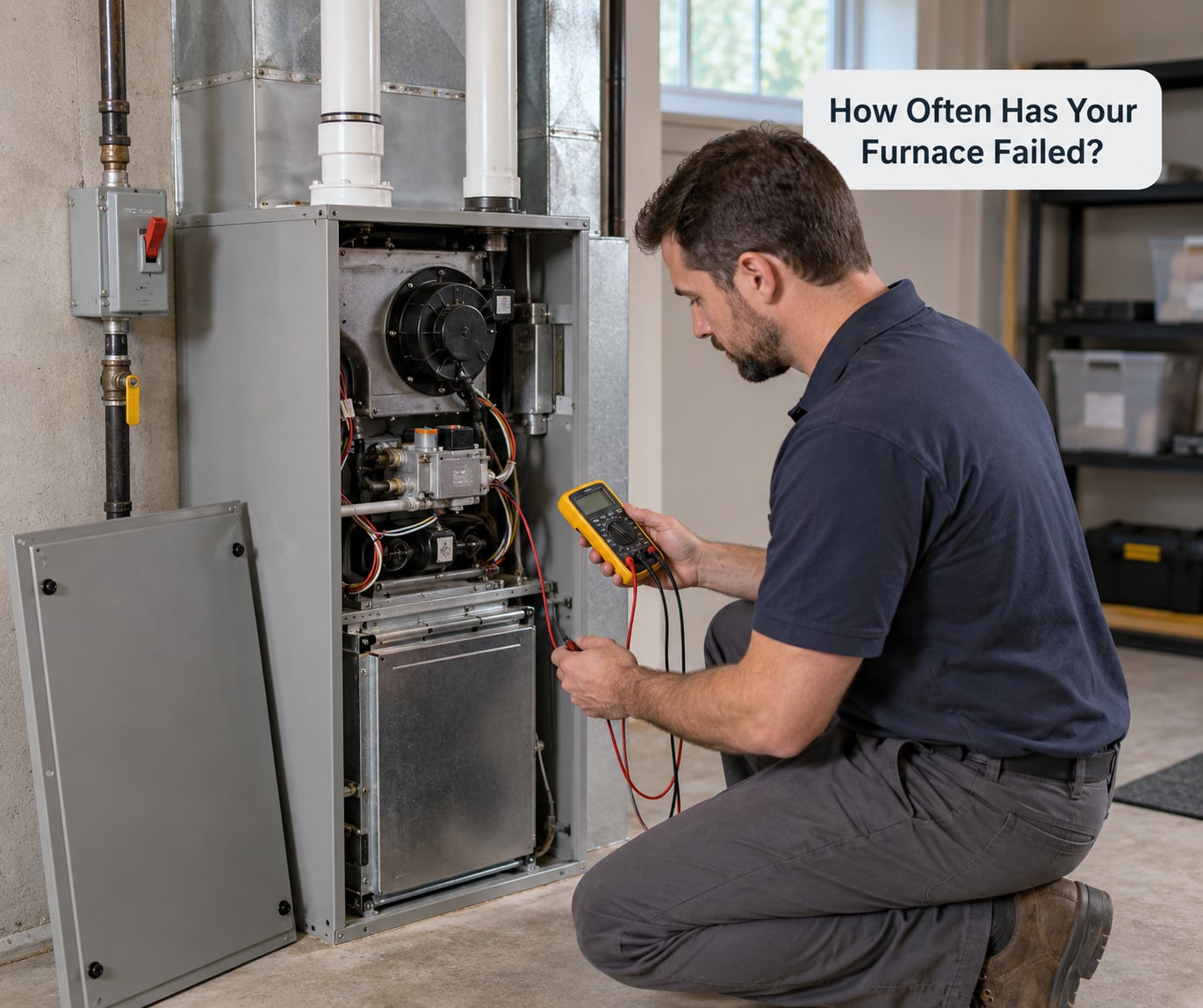
One breakdown is an event. Several breakdowns in a single heating season is a pattern, and that pattern is where most owners stop deliberating and start shopping for a new furnace.
The arithmetic that persuades people is cost per year of service. A repair on a 6-year-old furnace might buy 7 to 12 more good years. The same repair on a 17-year-old furnace might buy 1 to 3, and buyers on r/hvacadvice describe the exact version of this problem: an aging unit with a major component failing and a heat exchanger warranty that may or may not still apply.
Type of failure matters as much as count. A failed capacitor, a clogged filter or a miscalibrated limit switch points at one small thing. A heat exchanger crack, a seized blower motor or a control board that has gone dark points at the system, because those repairs tend to be followed by others within a season or two.
Is Your Furnace Still Efficient and Safe?
Efficiency loss shows up on the bill before it shows up anywhere else. A 70 percent AFUE furnace running about 150 dollars a month in winter can drop to roughly 110 dollars on a 95 percent model, which works out to around 480 dollars a year. Over an 18 year lifespan that gap adds up to several thousand dollars, which is why replacement often pays for itself on energy alone.
Age matters here more than for repairs. A new 90 to 95 percent furnace also runs with a variable-speed blower, holds humidity better in winter and can pair with a smart thermostat, and the comfort difference shows up in the first week.
Safety trumps every calculation on this page. If a carbon monoxide detector sounds, or you smell a sharp burning odor, or you see a yellow or orange flame through the burner window, get everyone and pets out of the house and call the fire department or your gas utility from outside. Decide about repair or replacement afterward.
A cracked heat exchanger sits in the same category. It is a safety defect, not a comfort defect, and a properly patched heat exchanger is not a repair most homeowners should accept. Corroded cabinet panels, a failed vent or a persistent sewer smell near the unit all deserve the same quick professional evaluation.
What Signs Mean You Need a Furnace Repair?
Repair is the sensible call when the symptom traces to one small, replaceable part and the rest of the furnace is healthy.
- The air filter has not been changed in months, and airflow dropped when you swapped it.
- The thermostat is unresponsive, has no display, or the schedule keeps resetting.
- The furnace will not start at all on a cold morning, which often means a failed igniter or flame sensor.
- It starts, runs briefly, then shuts off, a classic limit switch or airflow complaint.
- Airflow is weak, one room stays cold, or a duct damper closed itself.
- The blower rattles, squeals or grinds, which points at the motor or a loose wheel.
Routine items like filters and thermostats are straightforward. Short cycling where the unit runs and stops every few minutes is worth a diagnosis rather than a guess, because it is caused by airflow, a dirty coil, an oversized unit or a failing part, and only one of those is fixed by replacing a component.
Keep in mind what does not belong in the repair column: an odor of burning, a detector sounding, a visible yellow flame, or a unit that has failed several times this season. Those are urgent, and they are evaluated rather than fixed on the spot.
What Signs Mean It Is Time for Furnace Replacement?
Replacement is the sensible call when the furnace is past the midpoint of its expected life and something expensive has already failed.
- The unit is 15 years or older and has had its first major component failure.
- It has broken down repeatedly within one heating season, even if each individual repair was minor.
- Winter bills have climbed steadily over several years despite filter changes and a tune-up.
- The heat exchanger is cracked, or combustion problems have shown up as a yellow flame or odor.
- Repair costs keep landing near half or more of what a new system costs.
- Parts for the model are discontinued, so repairs depend on generic components or a unit nobody stocks.
- You are staying in the home for a decade or more and want the efficiency and warranty coverage of new equipment.
Then there are the reasons to hold off, which honest contractors will mention too. A furnace under 10 years old with one minor fault deserves a repair. So does a unit covered by a parts and labor warranty, since the math changes completely when the parts are covered. And if the real problem is undersized ductwork or a house that needs envelope work, a new furnace will not fix the cold bedrooms.
A furnace that still runs but needs its cover removed to operate gets talked about in homeowner forums constantly. Treat that as a genuine fault worth a professional diagnosis, not as normal behavior to live with.
What Should You Ask an HVAC Contractor?
Ask for these in writing before you sign anything. It takes ten minutes and it is the difference between a quote you can compare and one you cannot.
- What exactly failed, in part names, and what evidence supports the diagnosis?
- Itemized costs separating labor, parts, diagnostic fee and any permit work.
- Your furnace’s age, model and serial number, plus how much service life a technician expects from it.
- The repair scenario and the replacement scenario, both priced, so you can compare them side by side.
- Efficiency estimates for a replacement, including expected annual savings on your current bill.
- Warranty terms on parts and labor, plus any utility rebates or tax credits you qualify for.
- Whether your maintenance history supports a longer remaining life.
- How long the quote is valid, and whether parts are ordered specifically for your model.
Homeowners worry about being steered toward a sale, and the signs are fairly consistent: a replacement recommendation before any diagnostic testing, no part numbers offered, pressure to decide on the spot, or a quote that expires the same day. A technician who will write down the failing part, quote both paths and tell you that repair makes sense has nothing to gain from rushing you.
If the first recommendation is replacement and the furnace is 12 years old or newer, get a second opinion. Homeowners in r/homeowners and r/hvacadvice consistently describe the same confusion, one technician says repair and another says replace, and there is no way for a homeowner to adjudicate that alone.
How to Choose Between Furnace Repair and Replacement
Match your situation to the closest case below.
- A younger furnace with an isolated fault: repair. Under 12 years, one failed component, repair well under half the price of a new unit. You keep a working machine with most of its life ahead of it.
- An aging unit with recurring failures: replace. Past 15 years, several breakdowns in a season, and each repair is buying one to three years instead of a decade.
- Large efficiency gains available: replace. Moving from a 60 to 70 percent unit to a 90 to 95 percent model adds roughly 480 dollars a year in savings and improves comfort, which is money you recover while you still live there.
- Any safety concern: stop deliberating and get an evaluation today. Carbon monoxide, a cracked heat exchanger or combustion trouble is a safety decision first.
- Selling or moving within a few years: repair. Homeowners planning to sell generally repair and pass the problem on rather than installing a new system they will not enjoy.
- A planned renovation or addition: replace while the walls are open, since duct changes cost far less at the same time.
When to Replace vs Repair Your Furnace: Which Option Wins?
Repair when the furnace has real service life left and the fault is isolated to one minor part. Replace when safety, efficiency, cost or a pattern of failures makes the repair a poor investment.
In one sentence: repair a young furnace with a small problem, replace an old furnace with a big one, and never repair around a safety defect.
Frequently Asked Questions
How old is too old to repair a furnace?
Once a gas furnace passes about 15 years, most contractors treat replacement as the default and repairs as the exception. That is a rule of thumb, not a law. A 22 year old unit that heats evenly, has a documented service history and needs a 300 dollar part can be worth repairing. A 16 year old unit that has failed three times and bills 40 percent more than it used to is not.
Is it worth repairing a 20-year-old furnace?
Sometimes, and it depends on what broke. At 20 years the furnace is past the typical 15 to 20 year lifespan, so a repair should be weighed against a full replacement rather than assumed to be worthwhile. If the failing part is minor and the unit heats the house evenly, repairing buys you time at a fraction of replacement cost. If the heat exchanger, blower motor or control board has failed, replacement usually costs less over the next few years.
What does a furnace repair typically cost?
Minor part repairs such as a thermostat, igniter, flame sensor or limit switch usually run a few hundred dollars. A blower motor lands around 900 to 1,500 dollars. A cracked heat exchanger runs in the low thousands and can approach 4,000 dollars, which is why it pushes most owners toward replacement. Ask whether the diagnostic fee is credited toward the repair so you are not paying twice for the same visit.
What furnace problems require immediate attention?
A sounding carbon monoxide detector, a burning odor, a yellow or orange burner flame, or a unit that has shut down repeatedly all need action today. Leave the house with everyone in it, including pets, and call the fire department or gas utility from outside. Do not reset the unit and wait to see what happens. Once the home is safe, a licensed technician can evaluate whether the cause is a repairable part or a reason to replace the system.
Should I repair my furnace or replace it with a heat pump?
A heat pump is worth considering when your furnace is at the end of its life, when electricity rates are favorable in your area, and when your ducts can carry air rather than only heat. In a mild climate a heat pump can handle the whole heating season. In a hard winter you often keep the furnace as backup, which is the dual-fuel setup. Have a contractor run load calculations and duct sizing before dropping a furnace, because an undersized heat pump runs expensively and never quite catches up.
Does a furnace warranty cover the blower motor or heat exchanger?
It depends entirely on the brand and the length of the term. Manufacturers often carry long parts warranties of 10 to 20 years on the heat exchanger and shorter full coverage of 5 to 10 years on components like the blower motor, but labor is commonly covered only for the first few years. Check the model number against the manufacturer warranty lookup before you accept either a repair or a replacement quote, because an active parts warranty can flip the entire decision toward repair.
Conclusion
Repair a furnace that is young, heats evenly and failed once on a minor part. Replace one that is past 15 years, has failed repeatedly, bills more than it used to, or has any combustion or carbon monoxide concern. When the numbers sit in the middle, price both paths in writing and read the warranty before you sign.
Start today by finding your furnace’s model and serial number, pulling out last year’s service records, and writing down what you are actually observing, the noises, the rooms that stay cold, the change in your bill. That short list is what a good technician needs to give you an honest answer instead of a sales pitch. We re-checked the figures for 2026, and prices move, so get current quotes locally before deciding.