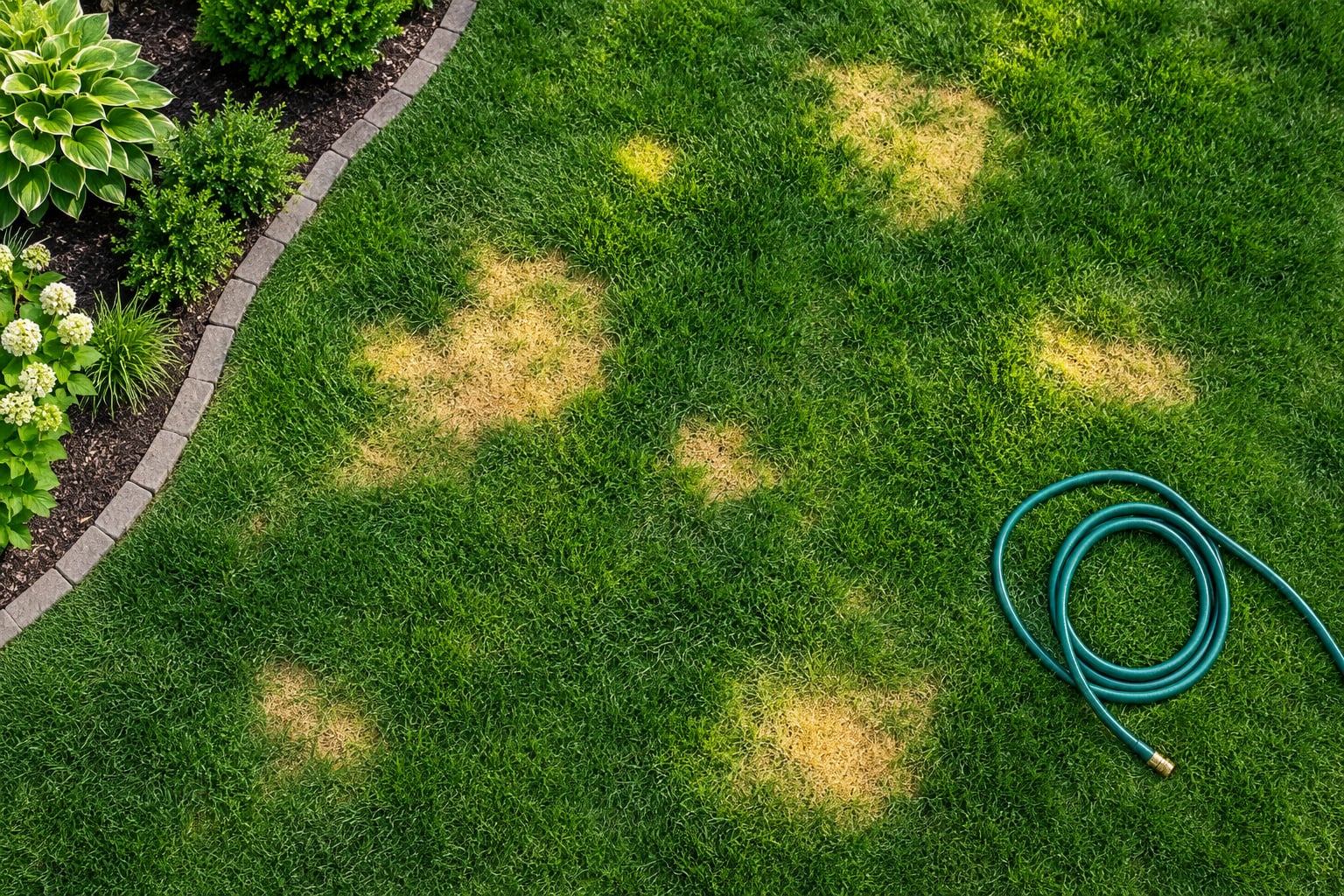
If your lawn is developing yellow patches instead of fading evenly, something is affecting it in specific spots rather than across the whole yard. Watering problems, nutrient shortages, pet urine, soil compaction, pests, fungal disease and chemical burn all leave a different signature on the grass, and the shape of the patch is usually the first clue.
Most of these problems are diagnosable in about ten minutes with a trowel and a glass of water. This guide walks through nine causes, how to tell each one apart from the others, and the correction that actually solves it rather than masking it with another product.
Table of Contents
- What Causes Yellow Patches in Grass?
- How to Identify the Cause Before You Fix It
- Why Is My Grass Turning Yellow in Patches? 9 Common Causes
- 1. Drought Stress or Uneven Watering
- 2. Overwatering and Poor Drainage
- 3. Nitrogen or Iron Deficiency
- 4. Dog Urine and Other Animal Waste
- 5. Grubs, Sod Webworms, and Other Lawn Pests
- 6. Fungal Diseases
- 7. Compacted Soil, Roots, or Buried Objects
- 8. pH Imbalance or Salt Damage
- 9. Recent Lawn Chemicals, Mowing, or Renovation Stress
- How to Fix Yellow Patches in Grass
- When to Call a Lawn-Care Professional
- Frequently Asked Questions
- Can yellow grass patches spread?
- What color do the grass blades turn from too much fertilizer?
- Should I water yellow grass every day?
- How do I know if yellow patches are caused by grubs?
- Will dead yellow grass grow back?
- Is it safe to put fertilizer on yellow spots?
- Start With a Simple Lawn Check
What Causes Yellow Patches in Grass?
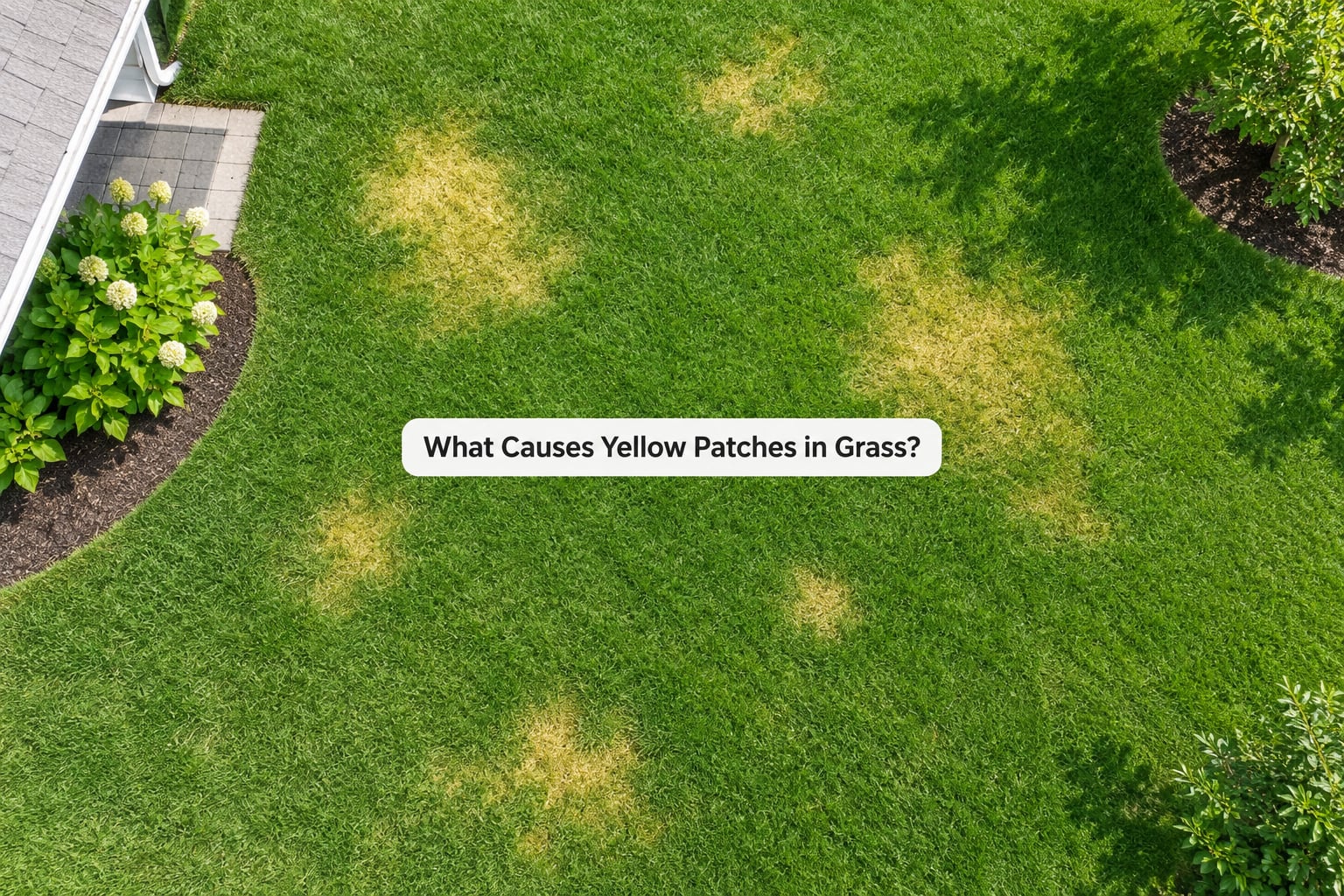
Yellowing happens when grass stops making chlorophyll, the pigment that turns blades green. Stress of any kind can interrupt that process, but a patch is a clue: something local is happening in that spot, and it is not uniform across the lawn.
Six things narrow it down fast. Patch shape tells you a lot, patch size usually maps to how long the problem has been there, location near a driveway or downspout points to heat or water, grass type sets the baseline expectations, season changes what is normal, and your watering pattern explains a surprising share of cases.
Location is worth dwelling on. Patches along a driveway, sidewalk, or south-facing wall are classic heat and reflected-heat stress. Patches near a downspout are almost always wet-root rot or leaching. Patches in the middle of an open lawn with no obvious trigger often turn out to be pet urine, a buried object, or a compacted traffic lane.
One thing to rule out first is dormancy. Cool-season lawns naturally look pale or straw-colored in late summer and winter, and that uniform fade is normal. Patchy yellowing inside an otherwise green lawn is a different problem.
How to Identify the Cause Before You Fix It
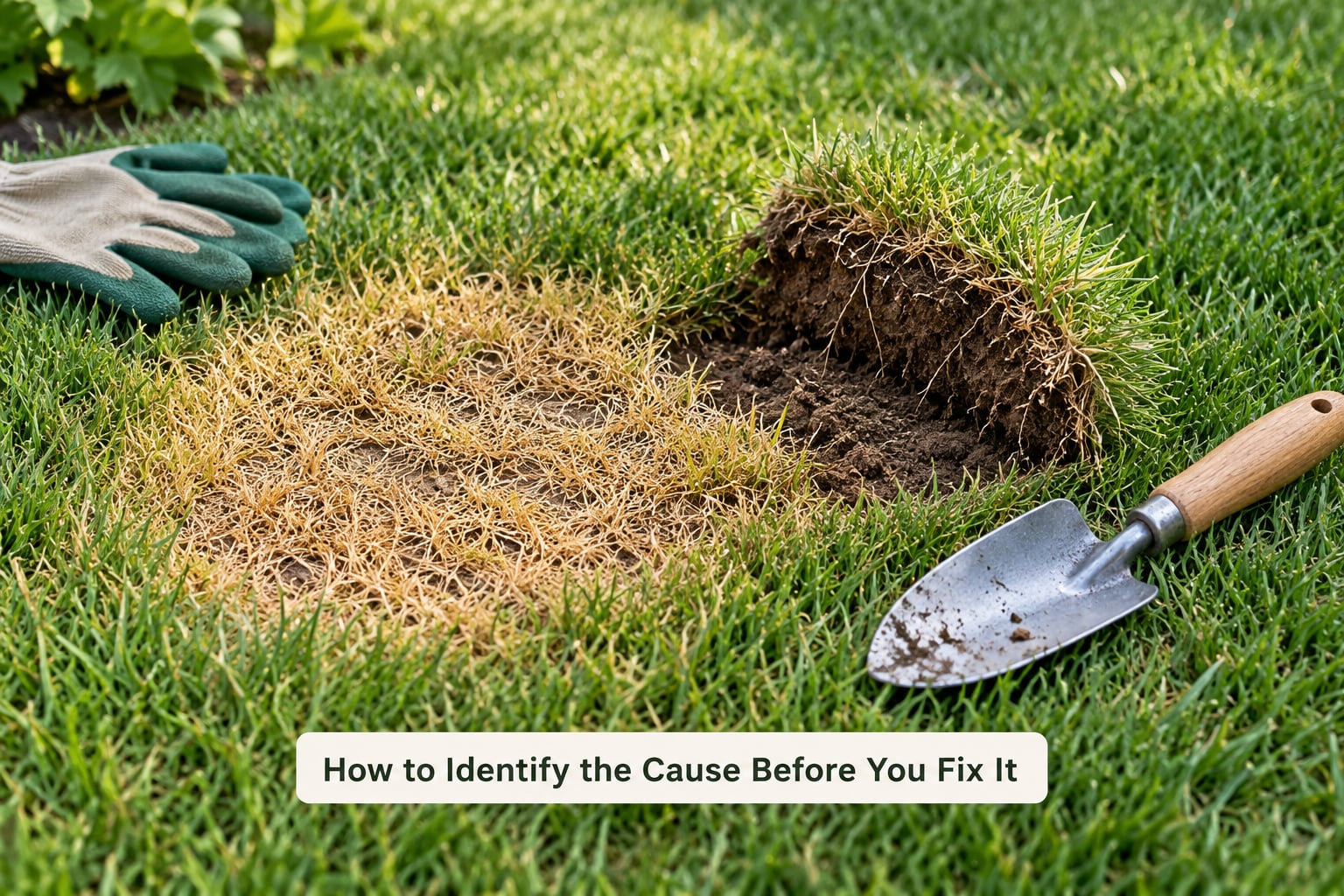
Start with the shape. Walk the perimeter of the affected area and note whether it is a clean circle, a ragged irregular blob, a straight line or band, or a broad continuous area. Then work down into the grass itself.
The blade check: pull a few blades from the edge of the patch. Healthy blades feel firm and snap. Blades that feel papery, slimy or break off mid-pull are telling you something different from blades that simply look pale.
The tug test: grab a handful of turf and pull up. Soil that comes with it in a solid mat means roots are holding on. Turf that peels away like a loose carpet with almost no roots attached points to root damage from grubs, root rot, or compaction.
The soil check: dig four inches down and feel it. Saturated, spongy, sour-smelling soil means waterlogging. Powdery, dry soil that repels water means drought or a hydrophobic thatch layer. Also check whether a sprinkler head in that zone is aimed at the patch or blocked, which creates a bright arc or stripe.
The timeline check: think back about the last four to six weeks. Fertilizer application, herbicide, new sod or seed, a rain event, a change in mowing height, and pet activity are all common triggers. The date you noticed the problem matters as much as the way it looks.
| Patch shape | What it usually means | Key identifier | First move |
|---|---|---|---|
| Small circle with a darker green center | Dog urine | Bright green ring around a straw-colored middle | Rinse the area, flush the pet’s usual spot |
| Ragged irregular patch that expands slowly | Fungal disease or insect feeding | Distinct margin, sometimes with a darker wet-looking edge | Check blades for lesions, webbing or powder |
| Straight line or evenly spaced band | Fertilizer or herbicide spreader pass | Edges match application passes exactly | Stop that product and water the area deeply |
| Long streak or narrow wedge | Mower scalping or dull blade tear | Bleached tips, torn frayed blade edges | Raise the cut height, sharpen or replace blades |
| Large, soft, diffuse area | Overwatering or poor drainage | Spongy soil, mushrooms, foul odor at the roots | Cut irrigation, improve drainage, add organic matter |
| Broad fade in open sun near concrete | Heat or drought stress | Footprints stay visible, blades rolled into tubes | Deep infrequent watering, raise mowing height |
| Patch along a roof drip line or foundation | Dry soil under an overhang, or constant saturation below it | Overhang drought or foundation drip | Check moisture directly under the edge |
This table is a starting point, not a verdict. Two causes often overlap: chinch bugs show up as irregular patches that look a lot like a fungal infection until you part the grass and find the insects.
Why Is My Grass Turning Yellow in Patches? 9 Common Causes
1. Drought Stress or Uneven Watering
Dry soil is the most common single cause. Grass under drought stress goes pale first at the tips, then folds or rolls into narrow tubes to conserve moisture. Your footprints stay pressed into the lawn for minutes instead of springing back, which is the fastest field test there is.
Uneven irrigation is the sneakier version. A sprinkler head aimed away from one zone, a broken head spraying one corner, or a valve stuck at partial open leaves a pale arc or wedge that matches the spray pattern exactly. Underground leaks and dry spots far from the dry-looking grass are common in older systems.
Fix it by watering less often and longer. Deep, infrequent irrigation encourages roots to travel down for moisture, which is what builds drought tolerance. Adjust head aim, check each zone with a catch can, and add rain gauges where runoff collects downhill.
2. Overwatering and Poor Drainage
Saturated soil has almost no oxygen left, so roots suffocate and stop taking up nutrients no matter how much fertilizer you add. The grass yellows while the soil stays wet, and the difference from drought is the soil under your hand.
Warning signs include spongy soil that squishes when you step on it, mushrooms popping up overnight, a sour smell when you dig, mushy brown roots that shed easily, and algae or moss on the surface. Yellowing that appears right after heavy rain or a week of frequent short sprinklings points the same direction.
Fix it by cutting back frequency first, then improving the ground. Add compost or other organic matter to loosen the soil, correct grade or drainage problems in low spots, and check that flat areas are not holding water against a foundation edge. Avoid cutting a lawn wet, since that compounds compaction.
3. Nitrogen or Iron Deficiency
Nitrogen drives chlorophyll production, so a shortage shows as uniform pale green to yellow, usually starting on the oldest blades and spreading across the whole lawn. Iron deficiency looks different: the newest growth stays yellow while the veins and lower leaves hold their color, giving a striped appearance.
Patchy nitrogen shortage happens where grass sits in poor soil, receives heavy runoff, or has been starved under trees and large shrubs. Iron chlorosis is almost always a pH symptom rather than a missing-iron symptom, because high soil pH locks iron out even when the soil is full of it.
Before applying anything, pull soil samples and send them to a lab. Then correct pH first, feed nitrogen evenly in the season your grass actually grows in, and use slow-release formulations on slopes and near hardscapes where runoff strips nutrients.
4. Dog Urine and Other Animal Waste
This is the easiest spot to identify and the one most often mistaken for disease. Urine burns the grass, and the edge of the burn takes up more nitrogen than the interior, so you get a straw-colored center ringed by grass so dark green it looks painted.
Look for the size. Dog spots are usually eight to twelve inches across. They appear in the same few places every time, often along a path the dog uses or a corner the dog likes. The dark green center is the tell; fungal rings look brown, gray or tan instead.
To repair, flush the spot with plenty of water, loosen the soil, and re-seed or re-sod once the ground is workable. To prevent it, rinse the area with a hose after the dog relieves itself and keep the grass well watered through the season so nitrogen is already circulating. Some owners also place a stone or paver flat at the corner the dog favors. A commercial spot repair product containing ammonium formate can help neutralize existing burns.
5. Grubs, Sod Webworms, and Other Lawn Pests
Grub damage is the classic cause of turf that lifts like a peelable carpet. The roots are gone, so the mat separates cleanly, usually in late summer when adult beetles have been laying eggs and the larvae have hatched.
Cut a square foot out of turf, flip it over, and look at the roots and soil side. A handful of white, C-shaped grubs with brown heads in the top two inches confirms it. Few or none, and the lawn pulls up fine, and you have a different problem.
Sod webworm damage shows up in irregular patches where blades are chewed down to short stubs, often with fine webbing and green pellets of frass at the soil surface. Chinch bugs cluster in hot, sunny areas next to driveways and sidewalks, where they kill the turf from the crown. Part the grass with a hand at the patch edge and look for small black-and-white adults and nymphs moving to the light.
Correct insect damage by fixing the conditions that invited it, then treat based on the confirmed pest and its life stage. Treat at the right threshold rather than on a fixed calendar, and prefer products targeted at the specific insect. Avoid blanket pesticide applications that also take out beneficial insects in the soil.
6. Fungal Diseases
Fungal lawn diseases spread outward from a point and are usually worse in warm, humid, over-watered conditions with long leaf wetness. Brown patch forms wide circular areas with a tan center and a darker, sometimes purple-brown margin. Dollar spot makes small straw-colored flecks an inch or two across that expand and merge. Rust leaves orange powdery spores on the blades that rub off on your hand.
None of these look like the sharp-edged green ring of a dog spot. If the patch keeps growing after you fix the watering, disease is more likely than urine damage.
The good news for warm-season lawns is that many fungal patch diseases decline once hot, dry weather arrives and the grass outgrows them. Cultural fixes do most of the work: water deeply and early, avoid evening irrigation, improve air movement, keep the grass adequately fed, mow at the proper height, and remove excess thatch. Add a fungicide only when the disease is confirmed, the weather is favorable for it, and you are not able to outgrow it.
7. Compacted Soil, Roots, or Buried Objects
Compaction squeezes air out of the root zone. In compacted areas, roots cannot expand downward, so the lawn thins, turns yellow under traffic, and holds puddles. Repeated foot or mower traffic on the same line is a common pattern.
Dig down and look. Instead of dark crumbly soil, you may find dense, brick-like clods and a root system that stops an inch or two down. Roots circling and matted in the top few inches point to a too-thick thatch layer that the grass cannot push through. Construction debris, a buried rock, a utility line or an abandoned septic tank creates a patch with the same yellow look and no other explanation.
Fix compaction with core aeration in spring or fall, then water compost or other organic matter into the holes so the improvement lasts. Pull up loose-laying sod and remove buried debris. Patch heavily trafficked areas with a turf grass that handles foot traffic better than the surrounding mix.
8. pH Imbalance or Salt Damage
Soil pH controls which nutrients grass can actually absorb. Below the ideal range, nutrients lock up and grass yellows even in fertilized soil. Above it, iron is the first casualty. Test rather than guess, since a jar test only tells you the obvious and lab tests tell you the buffer capacity.
Salts arrive from two directions. Road and sidewalk de-icing salt washes into the soil edge in winter, damaging grass along curbs and driveways, and mature trees nearby. Fertilizer spilled in a pile also burns a patch, sometimes the size of the spill, and looks similar.
Fixing pH takes planning, because you can swing it past the right point and create a new problem. Test at least a year before planting or reseeding, work in sulfur to lower pH and lime to raise it, and re-test to track progress. Leach salted soil with deep watering after the ground thaws, and keep salt out of the spreader hopper.
9. Recent Lawn Chemicals, Mowing, or Renovation Stress
Herbicide injury shows up in straight lines and evenly spaced bands that follow the spreader passes exactly, often appearing weeks after the application. Selective weed and feed products can slow or discolor the healthy turf alongside the weeds. Fertilizer burn is more abrupt: a strip or patch that browns and crusts within days.
Mower damage is frequently misread as disease. Dull blades tear the tips instead of cutting them cleanly, producing pale or bleached ends. Mowing too short, called scalping, strips the leaf surface the plant uses to feed itself and exposes crowns to heat, which is why strip-mowing paths turn pale first.
Changing grass type or laying new sod also shocks the lawn. Recent renovation, overseeding, or a switch in mowing height all reset roots and expose stress that would not have appeared before. Once you know the source, stop the exposure, water deeply and consistently, and hold off on fertilizer for about two weeks so the grass can recover without more chemical load.
How to Fix Yellow Patches in Grass
Fix the cause, not the symptom. Loading a brown patch with nitrogen when the real problem is a leaking valve just means you buy a thicker lawn in two weeks and the same patch returns in August.
Work in this order. First, stop the damage source: water down an over-applied product, correct irrigation coverage, keep pets off the affected areas, or change the mowing height. Second, fix the ground, since compaction, poor drainage and thatch block everything else. Third, treat what is confirmed: a specific pest, a specific disease, a pH correction, reseeding bare areas. Fourth, water deeply and consistently while the lawn repairs itself. Finally, wait and watch before adding anything else.
Recovery is not instant. Most yellow patches from watering problems begin to improve within two to three weeks of getting the irrigation right. Pest and disease patches take longer, often four to six weeks, because the grass has to regrow and fill in space. Dead turf needs seed or sod to come back; it will not repair itself, because a dead patch means dead crowns.
If grass pulls up easily with almost no roots, treat that as a root problem even when the surface looks healthy. If blades are still green and firm, the roots and crown are alive and the plant can recover on its own once the stress is removed.
When to Call a Lawn-Care Professional
Some problems are worth paying to have identified properly, especially if you are about to spend money on products. Get a professional assessment when patches spread steadily despite correction, when the affected area grows beyond a few square feet in a season, or when you are seeing large dead areas that pull up like carpet.
Call in a pest or disease diagnosis when you cannot confirm the culprit, when you are dealing with an unfamiliar insect or species of disease, or when a lawn has a history of recurring outbreaks. Grub and chinch bug treatments are time-sensitive to the insect’s stage, and a professional can read the thresholds correctly.
Get soil testing rather than guessing, especially if a lab test shows unusual results or repeated treatment has failed. And call in a specialist for irrigation work such as finding a leak, rebuilding a zone, or leveling a drainage problem.
Be cautious with any advice that arrives as a surprise. If a company shows up uninvited and offers to spray your lawn, check their licensing. Ask what product they plan to use, what target pest or disease it treats, and what happens if it rains within the next day.
Frequently Asked Questions
Can yellow grass patches spread?
Yes, some causes spread and others do not. Fungal diseases expand outward from a point, insect damage creeps along edges, and salt or drainage problems grow as the wet or salty area expands. Drought patches, dog urine spots, and fertilizer burn stay put once the source stops. Watch the margin for a week: an expanding edge means something is still active, while a static edge means the original problem has been corrected and recovery is underway.
What color do the grass blades turn from too much fertilizer?
Fertilizer burn usually turns grass yellow-white or straw-brown first at the tips, then browns and dries out. It often appears as a strip or patch matching your spreader pass, and the affected grass may smell sour or slightly burned when wet. Because nitrogen is a salt, it pulls moisture out of root-zone soil, so symptoms can be worst a few days after application and worse where the product collected.
Should I water yellow grass every day?
Usually not, unless the grass is wilted and you are in an active heat wave. Daily shallow watering keeps roots near the surface and makes the lawn less drought-tolerant, while over-watered soil loses oxygen and can rot roots. Check the soil four inches down first. Water deeply once or twice a week during dry weather, early morning, and adjust if a probe or your finger shows the root zone staying wet.
How do I know if yellow patches are caused by grubs?
The tell is the root test. Cut a one-foot square of turf, flip it over, and check the top two inches of soil for white C-shaped larvae with brown heads. If you find them and the turf lifts like a loose carpet, grubs are the likely cause. If the soil side is clean and the turf holds together, look elsewhere: chinch bugs above ground and disease both mimic grub damage closely.
Will dead yellow grass grow back?
It depends on whether the crowns are alive. Check a blade at the base of the patch. If the crown is firm and pale rather than brown and crumbly, the plant will regrow once you fix the cause, usually within two to three weeks. If the turf is dry, matted, and pulls up without roots, the crowns are dead. Rake out the dead material, loosen the soil, and re-seed or lay fresh sod in that area.
Is it safe to put fertilizer on yellow spots?
Only after you know what is wrong. Fertilizer on drought-stressed, diseased, or waterlogged grass makes the stress worse and can cause fertilizer burn, and it will not help pet urine spots at all. Feed only when the soil is moist and healthy, the pH is in range, and the lawn is actively growing. If you are reseeding a bare patch, use starter fertilizer instead and water it lightly and often until the seed germinates.
Start With a Simple Lawn Check
Take a trowel to the patch and start with two things: how the soil feels four inches down, and whether the turf lifts with roots attached or peels away clean. Those two answers rule out about half the causes on this list in under ten minutes.
Then match the shape. Circle with a green center means pet urine. Straight band means spreader passes. Ragged and growing means disease or insects. Soft, wet, diffuse means drainage. Check the season and your recent activities, then make one targeted correction rather than three.
Give it two to three weeks before adding anything else. A healthy lawn responds to the right fix quickly, and a patch that has stopped spreading is already recovering even if the color has not fully returned. If it keeps spreading after two weeks of correct care, that is the signal to bring in a pro.