Most homes need their carpet professionally cleaned every 12 to 18 months. If you have pets, small children, allergy or asthma symptoms, or busy hallways and entryways, shorten that to every 6 to 9 months.
That baseline comes up over and over in flooring guidance, and the forums say something useful next to it: plenty of people go two or three years between visits and their carpets survive fine. A schedule is a starting point, not a rule from the flooring police.
Table of Contents
- How Often Should Carpet Be Professionally Cleaned?
- What Factors Determine the Right Cleaning Schedule?
- Recommended Carpet Cleaning Schedule by Home
- How Often Should Carpet Be Professionally Cleaned for Homes with Pets?
- How Often Should Carpet Be Professionally Cleaned in Homes with Allergies?
- Professional Cleaning vs. Vacuuming: What Should You Do Between Visits?
- How to Tell When Your Carpet Needs Professional Cleaning
- How to Choose the Right Professional Carpet Cleaning Method
- What to Ask Before Hiring a Carpet Cleaning Professional
- Frequently Asked Questions
- How often should carpet be professionally cleaned in a typical home?
- Is professional carpet cleaning necessary if I vacuum every week?
- How often should carpet be cleaned if I have a dog or cat?
- How long does professionally cleaned carpet take to dry?
- Is steam cleaning better than dry cleaning for carpets?
- Can professional carpet cleaning remove old stains and pet odors?
- The Short Version: Pick a Date and Protect It
How Often Should Carpet Be Professionally Cleaned?
Here is the short version. Every 12 to 18 months for a normal household. Every 6 to 9 months if pets, kids, allergies, or heavy shoes are pulling dirt into the fibers every single day. Every 3 to 6 months for allergy-sensitive homes where dust mite and dander control is the goal.
The reason the number exists at all is that vacuuming has a hard floor. A vacuum lifts dry soil off the surface of the pile, but it cannot reach the grit that has worked down between the fibers and into the padding. That embedded layer builds quietly for months, and it is the layer people mean when they say the carpet feels dirty even right after vacuuming.
A professional cleaning is the only routine that pulls that layer back out. Hot water plus solution goes into the pile, and powerful suction drags the loosened soil and water back up. Doing it on a schedule means you are removing the soil before it compacts into the padding and starts to smell.
It also protects the investment. Carpet warranties usually require documented cleaning on a stated schedule, and carpet that is cleaned on time tends to keep its color and loft longer. Get the fiber content label off a closet floor or your sales paperwork, because it tells you both your likely method and how often your manufacturer expects you to call someone out.
What Factors Determine the Right Cleaning Schedule?
Six conditions move your number up or down, and they rarely matter equally. Sort out which two or three describe your house and you have your schedule.
Foot traffic. A hallway, stairway, or entryway that everyone crosses wears down faster than a bedroom nobody enters. Traffic lanes collect soil, crush the pile flat, and show wear as a lighter or darker path.
Pets. Shedding season alone can dump a surprising amount of hair and dander into the carpet, and accidents add urine odor that keeps coming back unless the pad underneath gets treated too.
Young children. Play on the living room floor means tracked-in dirt, spilled food, and craft supplies. The frequency that suits a nursery is rarely the frequency that suits a spare bedroom.
Allergies and asthma. Dust mites, pollen, and pet dander settle deep in the pile, where a standard vacuum barely touches them. Symptom severity matters more than the calendar here.
Cooking odors and smoke. Grease-laden airborne particles and smoke residue bond to carpet fibers. Households that fry often, or where someone smokes indoors, soil much faster than a comparable home that does not.
Carpet material and color. Wool, polyester, triexta, and nylon each behave differently under heat and moisture. Light-colored carpet shows soil sooner, so it needs attention earlier; dense wool tolerates a longer gap between visits; older loop-pile berber crushes easily and traps grit.
And the quiet one: how much outdoor dirt comes in. A home with a busy entryway, a dog who digs, or a garage-to-door path gets far more soil per week than the same house where everyone removes shoes at the door.
Recommended Carpet Cleaning Schedule by Home
Use this table as your starting point, then adjust with the signs in the next section. The ranges are the ones flooring guidance and carpet care standards settle on.
| Household profile | Recommended frequency | Main reason |
|---|---|---|
| Low-traffic home, no pets, no small children | Every 12 to 18 months | Maintenance, appearance, and keeping the warranty valid |
| Busy family home with small children on the floors | Every 6 to 9 months | Tracked-in dirt, spills, and steady fiber wear |
| Households with one or more pets | Every 6 to 9 months | Dander, hair, and odor removal before they set in |
| Allergy or asthma sufferers in the home | Every 3 to 6 months | Dust mite and allergen control between doctor visits |
| Indoor smokers or heavy indoor cooking | Every 6 to 9 months | Grease and smoke residue that vacuuming cannot lift |
| Hallways, stairways, and entryways only | Every 6 to 9 months, or spot-extract as needed | Traffic lanes wear and discolor ahead of the rest of the house |
| Renters and landlords between tenants | Once at move-out, ideally with documentation | Condition of the carpet at handover and deposit disputes |
| Light use, such as a second home or rarely visited room | Every 18 to 24 months | Very little soil load, but a periodic reset helps |
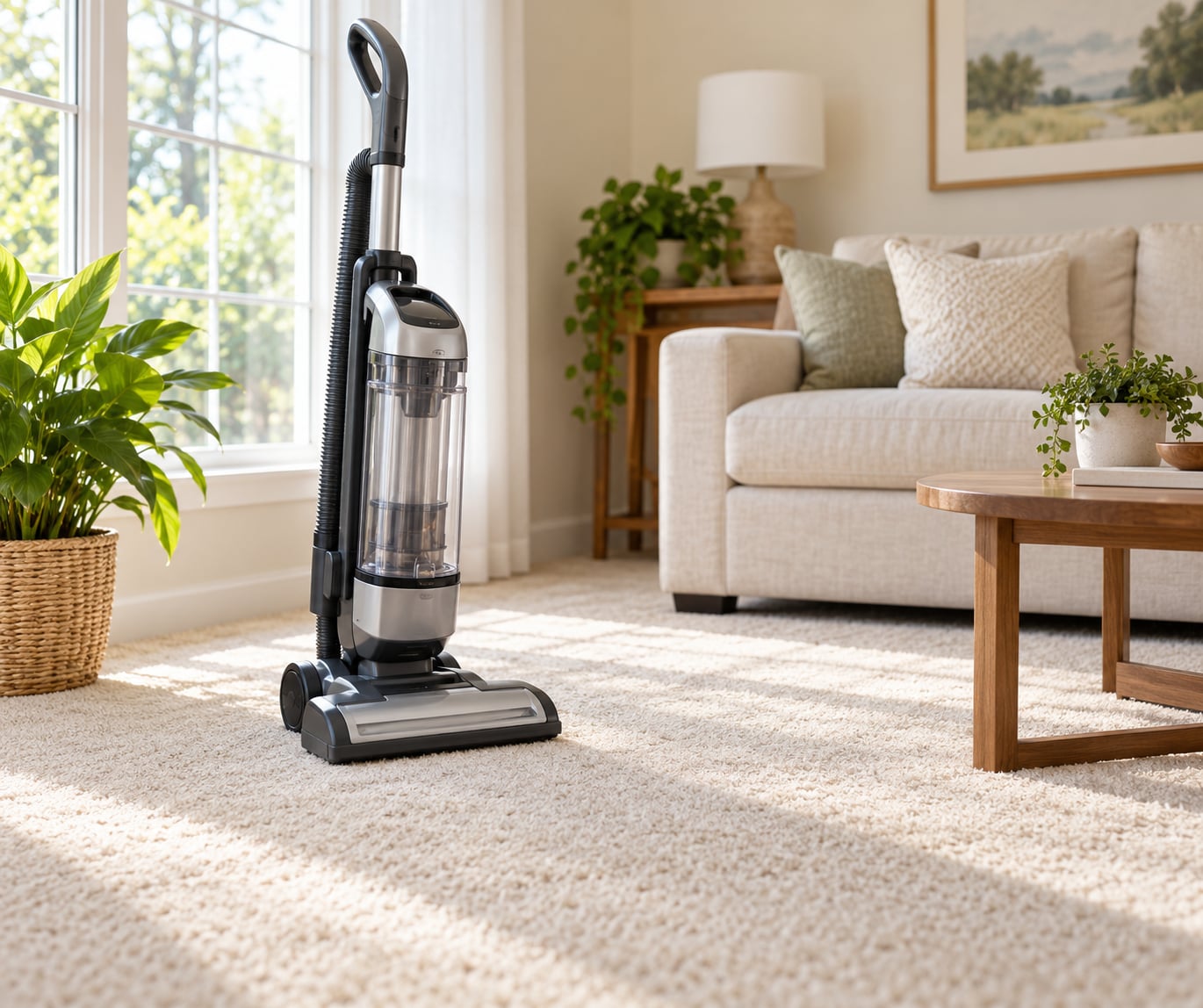
Between professional visits, the routine that matters most is vacuuming. Aim for at least once a week in low-traffic rooms and two or three passes a week in a family room, moving slowly enough that the beater bar actually agitates the pile.
Do a quick walk-through every few days looking for new spots, and deal with them while they are fresh. Blot from the outside of the stain inward with a clean white cloth. Rubbing pushes the spill deeper and spreads it.
How Often Should Carpet Be Professionally Cleaned for Homes with Pets?
Every 6 to 9 months is the working number for a home with a dog or cat, and shedding season is the reason to book earlier rather than later. A heavy shedder can push enough hair and dander into the pile in a few weeks to make an otherwise clean room smell stale.
Accidents change the picture more than shedding does. Urine soaks through the carpet and into the padding, where the odor-causing residue stays wet. A surface clean removes the mark but not the smell, and the smell comes back weeks later, which is why homeowners on cleaning forums often describe exactly that cycle. Ask whether the quote includes pad treatment or a sub-surface rinse, and say plainly that you have odor problems.
Two or more pets, a long-haired breed, or more than one accident a month push you toward the 6-month end or even closer. One short-haired indoor cat in a quiet apartment sits comfortably at 9 to 12 months.
How Often Should Carpet Be Professionally Cleaned in Homes with Allergies?
Every 3 to 6 months is the interval most carpet care guidance gives allergy and asthma households, and it is driven by symptom severity rather than by how the carpet looks. Dust mites and pet dander live in the depth of the pile and in the padding, where a household vacuum removes very little.
Be clear about what a cleaning does and does not do. It removes a large share of what has settled in the carpet, but it is not a substitute for a medical plan, and it will not fix a problem that comes from dust mites in your bedding, bedding dust covers, humidity control, or a leaky crawl space. If your symptoms are serious, talk to your doctor about the whole picture and use carpet cleaning as one piece of it.
Allergy households get the most out of professional work when they pair it with the basics: a HEPA vacuum on a slow pass twice a week, mattress and bedding care on their own schedule, shoes off at the door, and ventilation after cleaning while the carpet dries.
Professional Cleaning vs. Vacuuming: What Should You Do Between Visits?
They are not competitors. Vacuuming is daily maintenance that keeps soil from ever reaching the padding. Professional cleaning is the occasional deep reset that removes what your vacuum has been pushing around for a year.
A workable plan looks like this.
Vacuum on a schedule, not when you feel like it. Twice a week in busy rooms, once a week elsewhere. Go slowly and overlap your passes, and use a hard floor tool rather than a beater bar on loop pile and cut pile carpet, where the bar can pull fibers loose.
Use mats at every exterior door. A walk-off mat catching two or three footsteps of dirt is what keeps that dirt out of the pile in the first place. It is the cheapest carpet care measure there is, and you can tell within a few days whether it is working by how fast the vacuum fills up.
Remove shoes at the door. Outdoor grit is the most abrasive thing your carpet meets, and it grinds fiber surfaces down as people walk.
Spot-clean immediately. Blot, never scrub, and work from the outside edge of the spill toward the middle. For pet accidents, remove as much as you can with a towel before anything wet goes down.
Rent a machine for the spot, not the room. If you rent or own an extractor for one accidental spill or one room, you have already made the mistake most people regret: rented units often put down more water than they take back up, and carpet that stays wet too long can grow mildew in the padding.
One note on frequency for renters and DIYers. Monthly is plenty for spot work on a high-traffic area, and running a rented machine over an entire carpet every few months leaves a lot of water sitting in the padding for very little benefit. That is the single strongest argument for calling a professional on a schedule instead.
How to Tell When Your Carpet Needs Professional Cleaning
Some warning signs are visible. A few are not, which is why the calendar matters in the first place.
It smells when you first walk in. That musty or stale note you stop noticing after ten minutes is the giveaway, because you have trained your nose out of noticing it.
The pile looks flat and dull. Freshly cleaned carpet stands up. A carpet that has lost its loft, or that shows a worn path from the door to the couch, is carrying compacted soil.
You can feel grit underfoot. Run your hand across the fibers. Crunchy, sandy texture means soil is past what the vacuum reaches.
Stains you cannot explain. Repeated spots in the same spot usually mean residue in the pad wicking back up through the fibers as the carpet dries, which is a pad treatment conversation, not a shampoo conversation.
Traffic lanes. Compare the hallway to the corner of a room nobody walks through. If the difference is obvious, the whole room is overdue.
Allergy symptoms that track the carpet. More sneezing in a carpeted bedroom than in a tiled room, or a reaction that shows up on the days you have been indoors, is a reason to bring the visit forward.
Pet accidents, repeatedly. Frequency of accidents, not just their existence, sets the interval.
And the opposite sign, which nobody advertises. If your carpet is staying damp long after the crew leaves, if you are getting a protectant or deodorizer pushed on you at every visit, or if you notice a ring after an easy-looking clean, your carpet is being over-shampooed. Residue left in the pile attracts soil faster than before, and the next clean looks less effective. That is a sign to change cleaners, not to clean more often.
How to Choose the Right Professional Carpet Cleaning Method
Check the fiber label first, then ask what method the cleaner intends to use and why. Most of the differences between companies are not about technique at all; they are about equipment and about how much water they leave behind.
| Factor | Hot water extraction | Dry cleaning and encapsulation |
|---|---|---|
| How it works | Hot water with cleaning solution is injected into the pile, then extracted with a powerful vacuum | A crystallizing polymer traps soil, dries, and is vacuumed away |
| Cleaning depth | Deep, into the pile and often the padding surface | Surface to mid-pile |
| Drying time | 6 to 24 hours with fans and ventilation | 1 to 2 hours |
| Best for | Heavy soil, pet stains, odor, allergy households, whole-room resets | Light maintenance, small areas, rooms you need back the same day |
| Fiber caution | Wool needs low heat and controlled moisture; avoid soaking | Safer on delicate fibers, but may under-perform on deep soil |
| Equipment note | Truck-mount units heat water on site and usually outperform portable machines | Portable, light equipment, easy room-by-room |
Wool and other natural fibers are the exception worth flagging. High-heat steam and over-wetting can shrink or felt them. Polyester and olefin tolerate heat poorly for the same reason, and a hot humid climate adds mold risk if the carpet stays wet past a day.
What a competent visit looks like is worth knowing before they start. A technician pre-inspects and tests the fiber for colorfastness, pre-treats spots, works section by section with dwell time, extracts, then grooms the pile in one direction so it dries evenly. Anyone who finishes in fifteen minutes on a 200 square foot room is not extracting anything.
What to Ask Before Hiring a Carpet Cleaning Professional
Get the estimate in writing and ask these before anyone touches your carpet. Forum threads about this topic repeat the same frustration: unclear pricing on the phone, then fees on the bill.
Are the technicians certified? IICRC certification is the standard most people in these discussions look for, and it is the one worth asking about by name.
Is the company insured and bonded? If they will not show it, that tells you something.
How is the price calculated? Per room, per square foot, or per cleaning area? Ask what counts as a room, and whether stairways, hallways, and walk-in closets are extra. A written quote with the method named beats a number from a phone call.
What is the travel or call-out fee? Small local companies often charge one, and nobody mentions it first.
What is included beyond the clean? Preconditioner, stain treatment, deodorizing, and a post-cleaning walkthrough should be stated. Furniture moving and block tabs are often separate, and you can save both by moving lightweight pieces yourself beforehand.
How long until it is dry, and what do you do meanwhile? Also ask for the cleaning warranty or re-clean policy in writing, and keep the receipt, the technician’s name, and a couple of photos of the carpet after it dries. If your carpet carries a manufacturer warranty, that documentation is the proof you will need later.
Finally, ask what is optional. A stain protectant is a reasonable add, and a sanitizing service you never asked for is a sales pitch. Real questions come from a homeowner who wants to know what the clean includes, not from a company with a hard close.
Frequently Asked Questions
How often should carpet be professionally cleaned in a typical home?
Most homes need a professional carpet cleaning every 12 to 18 months. That range assumes two or three people, no pets, and normal foot traffic. Shorten it to every 6 to 9 months if you have pets, small children, indoor smoking, or a hallway that everyone crosses. Lengthen it to 18 to 24 months in low-traffic rooms that barely get used.
Is professional carpet cleaning necessary if I vacuum every week?
Weekly vacuuming is the maintenance that keeps soil from reaching the padding, and it genuinely matters, but it has a limit. A vacuum lifts dry soil off the surface of the pile and cannot remove grit already embedded between the fibers. Professional extraction pulls that deeper layer out, which is why homes that vacuum constantly still show traffic lanes and dull color.
How often should carpet be cleaned if I have a dog or cat?
Every 6 to 9 months is a sensible starting point for a home with pets, and shedding season is a good reason to book earlier. If you have more than one pet, a heavy shedder, or regular accidents, move toward 6 months. For urine odor that keeps returning, make sure the quote includes pad treatment, since the residue sits under the carpet and not in it.
How long does professionally cleaned carpet take to dry?
Hot water extraction typically takes 6 to 24 hours to dry, depending on humidity, ventilation, and how much water the crew left behind. Dry cleaning and encapsulation dry in 1 to 2 hours. Speed it up with fans, air conditioning, or a dehumidifier, and keep people and pets off it until it feels dry to the touch, since walking on wet carpet slows the process and re-soils fibers.
Is steam cleaning better than dry cleaning for carpets?
Hot water extraction is better for most homes because it reaches deep into the pile and into the surface of the padding, which is what you need for embedded soil, pet stains, odor, and allergens. Dry cleaning and encapsulation work well for light maintenance and same-day turnaround, but they clean only the surface to mid-pile and leave more water behind. Wool carpet needs low heat and controlled moisture with either method.
Can professional carpet cleaning remove old stains and pet odors?
Professional cleaning removes most surface stains and a great deal of odor, but old stains that have wicked up from the padding are harder. Urine residue sitting under the carpet is why a smell can return weeks after a good clean, and that case usually needs pad treatment or a sub-surface rinse. Ask about it before booking, and get the fiber colorfastness tested first so the clean does not create a new problem.
The Short Version: Pick a Date and Protect It
Book the 12 to 18 month window now if you have pets, kids, allergies, or a busy entryway, and aim for 6 to 9 months instead. If your carpet has no warning signs and gets light use, 18 to 24 months is fine.
Then do the boring work that decides whether the cleaning lasts: vacuum twice a week in busy rooms, keep a walk-off mat at every door, shoes off at the entrance, and blot spills while they are still small. That is the answer to how often should carpet be professionally cleaned, and the four habits around it are what decide the answer next year.